
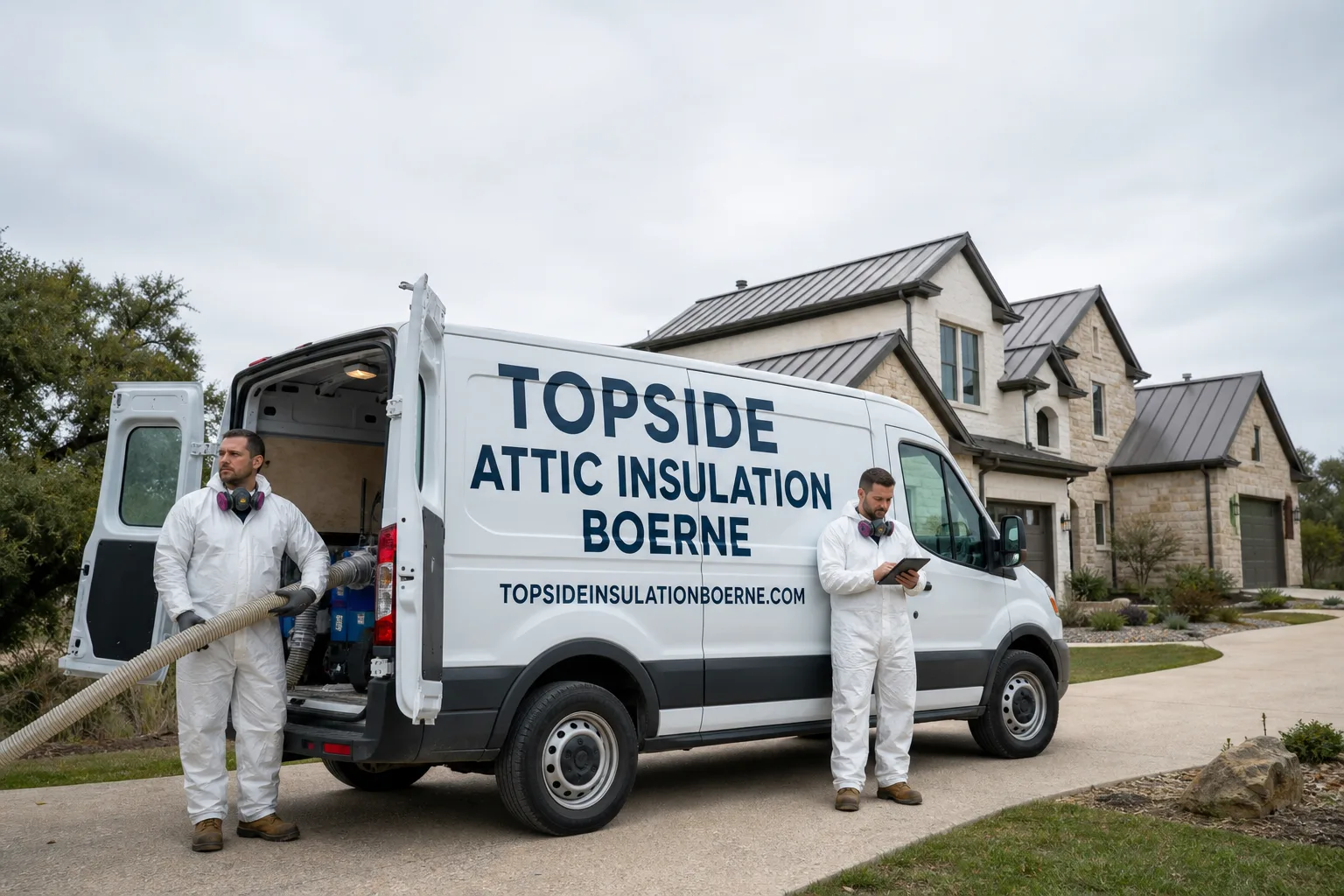
How Much Does Blown-In Insulation Cost in Boerne?
Blown-in insulation in Boerne, TX typically runs between $1,800 and $4,200 for a standard attic job, with most single-story homes in the 1,800-2,400 square foot range landing around $2,200-$2,800 when attic air sealing is included before the insulation goes in. The Hill Country climate - long summers above 100°F and attics that routinely hit 140-160°F - makes R-38 to R-60 the practical target, which affects both the volume of material and the final price.
Blown-In Insulation Cost Breakdown (2026)
The table below reflects actual project ranges we see in the Boerne market, covering Kendall County homes from Fair Oaks Ranch to the neighborhoods closer to Old Town. These are not national averages pulled from an aggregator - they reflect the local material costs, the attic configurations typical of Hill Country construction, and the access challenges that add time on jobs in communities like The Preserve at Alamo Ranch or Esperanza.
| Scope of Work | Typical Price Range (2026) | Notes |
|---|---|---|
| Blown-in fiberglass (attic only, no air sealing), up to 1,500 sq ft attic floor | $1,100 - $1,700 | R-30 to R-38 depth; existing partial insulation present |
| Blown-in fiberglass (attic only, no air sealing), 1,500-2,500 sq ft attic floor | $1,600 - $2,400 | R-38 target; single-story slab homes common in Boerne |
| Blown-in cellulose (attic only, no air sealing), 1,500-2,500 sq ft attic floor | $1,500 - $2,300 | Cellulose runs slightly cheaper per bag; R-38 to R-49 |
| Attic air sealing + blown-in fiberglass, 1,500-2,500 sq ft attic floor | $2,200 - $3,400 | Top plates, can lights, and penetrations sealed first; before/after blower-door numbers documented |
| Attic air sealing + blown-in fiberglass, 2,500-3,500 sq ft attic floor | $3,100 - $4,200 | Common in larger homes in Cordillera Ranch and Bella Vista |
| Insulation removal + air sealing + blown-in replacement | $3,500 - $6,500+ | Old fiberglass batt removal adds $800-$2,000 depending on depth and debris |
| Dense-pack blown-in for exterior walls (per 100 sq ft of wall) | $300 - $550 | Applies to older Boerne construction built before 2000 with empty wall cavities |
| Bonus room or knee-wall blown-in (add-on scope) | $400 - $900 | Common in two-story homes in Vintage Oaks and Heights of Boerne |
What These Numbers Include
Every price listed above assumes a written scope delivered before any work starts, a documented photo record when the crew leaves, and – for any job that includes air sealing – before-and-after blower-door readings so you can see the actual change in air-exchange rate. A blower-door test is a pressurization measurement that produces a single CFM50 figure, showing exactly how much conditioned air the home’s building envelope was losing. You get that number before the crew seals anything and again after they finish, so “better” isn’t a feeling – it’s a measurement.
What these prices do not include: insulation removal from a severely contaminated attic (rodent damage or heavy debris), repairs to attic sheathing, or HVAC ductwork sealing, which is a separate trade. If any of those conditions exist, you’ll know before work starts because it will be written into – or explicitly excluded from – the scope.
Boerne vs. San Antonio Metro Pricing
Jobs in Boerne tend to run 8-14% higher than equivalent square footage in central San Antonio neighborhoods like Alamo Heights or Stone Oak. The reasons are straightforward: drive time adds to labor cost, material delivery to Kendall County adds a small logistics premium, and the steeper rooflines on Hill Country custom builds slow attic-floor work compared to flat subdivisions built in the 2000s. That gap is real, and any quote that shows Boerne pricing matching inner-Loop San Antonio prices exactly deserves a careful read-through of what got left out.
What Affects Blown-In Insulation Pricing in Boerne
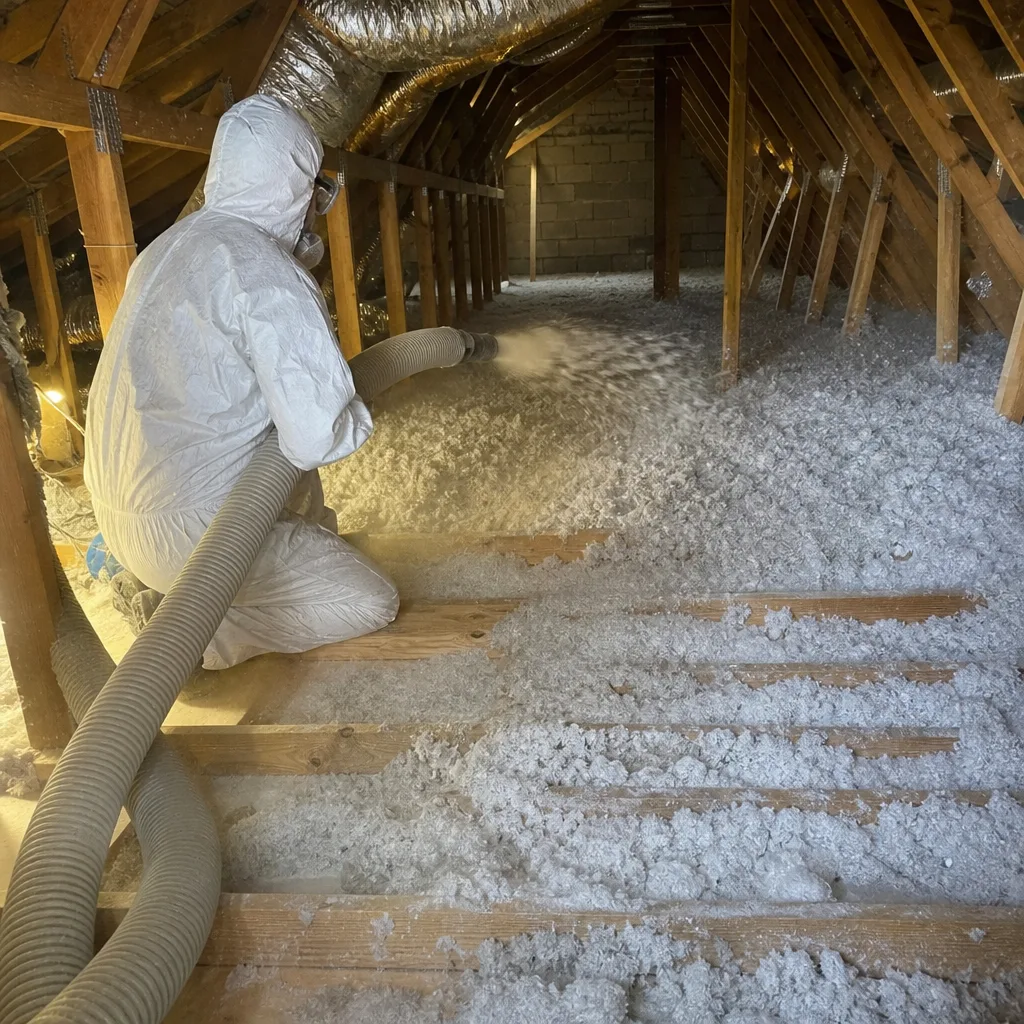
Six variables move the number more than anything else. Understanding them lets you read any estimate – ours or a competitor’s – and know whether the line items make sense.
- Attic square footage and configuration: A 2,000 sq ft single-story home in the Herff Ranch area has a large, relatively open attic floor that a crew can cover efficiently. A 2,000 sq ft two-story with multiple roof breaks, hip sections, and low-pitch areas over a garage takes measurably longer and requires more setup. Footage alone doesn’t tell the full story.
- Target R-value: Boerne sits in IECC Climate Zone 2B/3A, and the 2021 energy code for new construction targets R-49 in unconditioned attics. Existing homes built before 2010 often have R-19 or less – a significant depth difference that requires more material and bags. Going from R-19 to R-49 in a 2,000 sq ft attic means roughly 60-70 extra bags of blown fiberglass. That material cost is real.
- Air sealing before insulation: This is the item most often left off competitor quotes because it adds labor cost. Sealing top plates, attic penetrations, and recessed can lights before blowing insulation is the difference between insulating and actually reducing heat gain. In Boerne’s climate, unsealed can lights and top-plate gaps are the primary reason a freshly insulated attic still has high utility bills in July. We seal first, then insulate – not the other way around. Skipping this step keeps the quote lower and keeps the utility bills higher.
- Existing insulation condition: Homes in older sections of downtown Boerne and along Johns Road sometimes have original fiberglass batts that are compressed, moisture-damaged, or contaminated. Blowing over degraded insulation is cheaper upfront and meaningfully less effective. Removal runs $800-$2,000 depending on depth and what’s in there; that cost should appear in writing before anyone makes that call.
- Access difficulty: Attic hatches smaller than 22 inches, low-clearance areas under 18 inches, and attics with heavy HVAC equipment positioned near the only entry point all add time. Hill Country custom builds in Cordillera Ranch frequently have decorative ceilings that limit where a hatch can go. That’s not a reason to skip the job – it’s a reason to walk the attic before pricing it.
- Material choice – fiberglass vs. cellulose: Owens Corning AttiCat blown fiberglass and GreenFiber cellulose are the two primary options for attic work in this market. Cellulose has a slightly higher recycled content and runs a few dollars less per bag, but it absorbs moisture differently – relevant if there’s any roof leak history or elevated attic humidity, which we do see in homes near the Guadalupe River corridor in and around Boerne. Fiberglass is moisture-inert. Neither material is universally better; the right choice depends on what the attic inspection shows.
How to Save on Blown-In Insulation in Boerne
Understand the CPS Energy and AEP Rebate Programs
If your Boerne home is served by Bandera Electric Cooperative or receives service through any utility with a rebate program, insulation upgrades to code-minimum R-values can qualify for per-square-foot rebates. In 2025-2026, rebate amounts for attic insulation in this region have ranged from $0.10 to $0.25 per square foot of conditioned floor area, which on a 2,200 sq ft home represents $220-$550 off the installed cost. Ask any contractor you’re evaluating to identify which utility serves your specific Boerne address and whether the proposed scope meets rebate requirements. If they can’t answer that question, they probably haven’t filed the paperwork before.
Bundle Air Sealing and Insulation in One Visit
Scheduling air sealing and Blown-In Insulation services as separate jobs – common when homeowners don’t realize they go together – means two mobilization charges, two attic setups, and sometimes two rounds of insulation settling before the final depth is confirmed. Doing both in one scope saves $150-$350 in labor overhead and produces a better result because the crew isn’t blowing material into gaps they haven’t sealed yet.
Get a Blower-Door Test First
A home energy audit – specifically a blower-door test – tells you where the air is actually going before you spend money on insulation. In Boerne, we regularly see homes where the attic R-value reads at R-30 but the blower-door number is high because the fireplace chase, the attic hatch, and three bathroom exhaust fans are all leaking. Adding more insulation without fixing those gaps improves the number on paper but not the utility bill. The audit runs $200-$400 on its own, but on any job that includes air sealing, the reading is part of the documented scope.
Compare Written Estimates – Not Phone Quotes
A verbal quote is not a price. A written estimate that specifies the material, the R-value target, the square footage covered, the air sealing scope (or its absence), and the warranty terms is a price. When you bring a written estimate from any contractor to Envelope Insulation Co., Wes Okafor or a member of the team will read it with you line by line under the Free Second Opinion included with every consultation. That’s not a sales tactic – it’s how you identify what a lower quote left out.
Avoid Over-Insulating Without Air Sealing
The single most common way homeowners overspend on insulation in Boerne is paying for R-60 depth on an attic floor that still has open top-plate gaps and unblocked can lights. You will get a better performance result from R-38 with thorough air sealing than from R-60 with no air sealing. The material cost difference between R-38 and R-60 in a typical Boerne attic is $300-$700. That money is better spent on sealing first. The before-and-after blower-door numbers will confirm which approach moved the needle.
To request a free written estimate for your Boerne home – with no work starting until the price and scope are in writing – call (830) 529-7780. A live person answers; there’s no voicemail system to navigate.
Why Boerne Attics Are Different From Most Markets
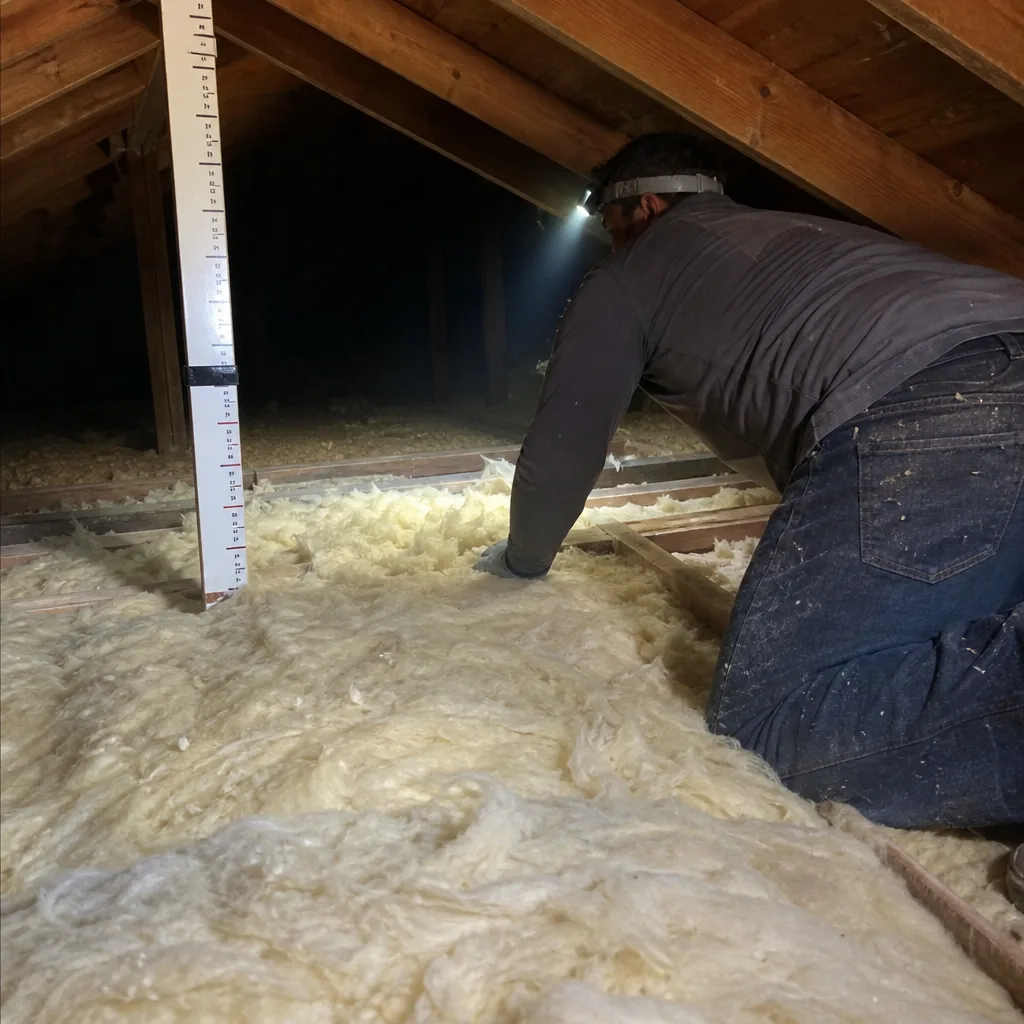
This isn’t filler – the Hill Country geography and building stock create specific conditions that affect how blown-in insulation performs and how it should be installed.
Boerne sits at roughly 1,400 feet elevation, which moderates temperatures slightly compared to San Antonio’s urban core, but the solar exposure on south- and west-facing roof decks is intense from April through October. Attic temperatures in homes without radiant barriers routinely hit 150-160°F on a July afternoon, which means the insulation below the roof deck is working against a massive thermal load. Blown-in fiberglass at R-49 slows that heat transfer substantially; without adequate depth, the attic floor is essentially a radiator pointed at the living space below.
The limestone soil and the caliche hardpan under much of Kendall County mean very few homes here have basements – the attic is the only accessible envelope component for most insulation upgrades, which raises its importance. And the cedar, live oak, and juniper surrounding most properties means attic debris – dust, pollen, animal intrusion, and occasionally cedar pollen buildup in soffit vents – is a real factor in insulation degradation over time. Homes in areas like Herff Ranch, the Hill Country Mile corridor, or properties backing to the Guadalupe watershed see higher attic humidity variance than homes in drier subdivisions further west on 46.
For our Blown-In Insulation in Boerne service, every attic inspection documents what’s actually in the space – not just the R-value reading but the condition of the material, the soffit ventilation, the presence of any rodent activity, and the visible air-sealing gaps. That documentation travels with the job.
Fiberglass vs. Cellulose: Which Makes More Sense in Boerne?
Both materials work. The question is which one fits the specific attic.
Blown-In Fiberglass
Products like Owens Corning AttiCat and Johns Manville Spider are the most common in this market. Blown fiberglass is moisture-inert, which matters in attics with any history of condensation or near properties with outdoor kitchens and pools that raise ambient humidity. It settles slightly over time – the settled R-value is what gets written into the scope, not the initial fluffed depth. It’s also slightly more resistant to wind disturbance during installation in attics with aggressive ridge ventilation, which is common in the steeper-pitched custom builds in Cordillera Ranch and Cascade Hills.
Blown-In Cellulose
GreenFiber and similar cellulose products are treated with borate as a fire retardant and pest deterrent. The borate treatment is genuinely effective and a real advantage in attics where rodent activity has been documented. Cellulose settles more than fiberglass, which means installers need to blow to a greater initial depth to hit the warranted R-value – the installer’s depth chart should account for this, and you can verify by checking the bag count on the job against the manufacturer’s coverage tables. Cellulose’s recycled content is typically 75-85%, which is a meaningful consideration for homeowners thinking about embodied carbon.
Material Cost Comparison in Boerne, 2026
- Blown-in fiberglass to R-49 in a 2,000 sq ft attic floor: approximately $700-$950 in material cost
- Blown-in cellulose to R-49 in a 2,000 sq ft attic floor: approximately $600-$850 in material cost
- Labor for either material at similar depths: roughly equivalent, within $75-$150 per job
Knauf, CertainTeed, and Rockwool products are also available for specific applications. There’s no product lock-in here – the material specified in any written scope is the material installed, and substitutions require written agreement.
What the Job Looks Like, Start to Finish
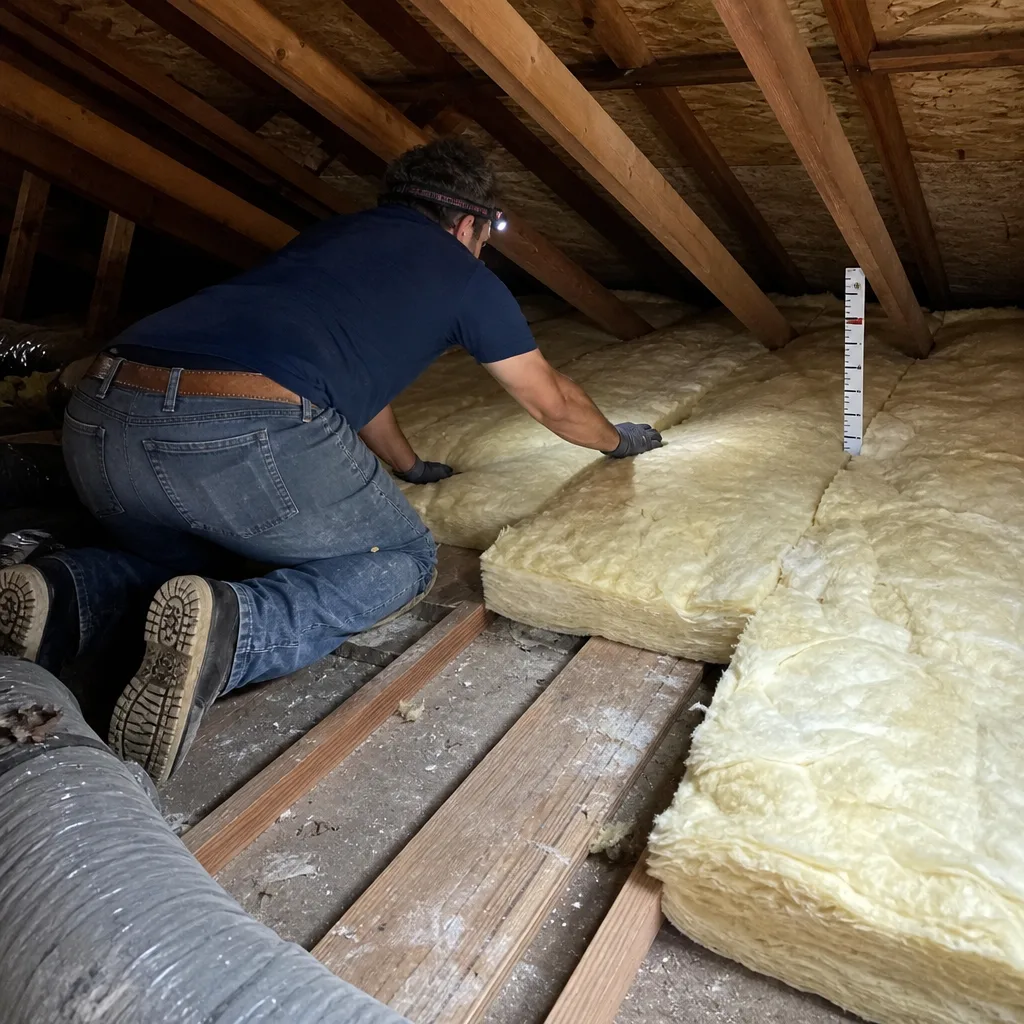
A lot of homeowners in Boerne have hired insulation contractors before and received a bag-count receipt and a handshake. Here’s what this process looks like instead.
Before Work Starts
A technician walks the attic and the exterior. The attic inspection documents current R-value, insulation condition, soffit and ridge ventilation, visible air-sealing gaps, and any signs of moisture or pest activity. If a blower-door test is included in the scope, it’s run at this point – a CFM50 number is recorded before any work begins. A written price and written scope are delivered. No work starts until both are signed.
Under Haven Standard Clause 1, this is non-negotiable: written price before any work starts, every time. That’s not a marketing promise – it’s the operating procedure Wes Okafor built into the company when Envelope Insulation Co. started operating in 2016, and it applies to every job regardless of size.
Air Sealing First
If air sealing is in the scope – and for almost every Boerne attic job, it should be – it happens before any insulation is moved. Top plates, electrical and plumbing penetrations, recessed can lights, attic hatches, and chimney chases are sealed using the appropriate material for each gap type. This step takes 1-3 hours depending on attic complexity and the number of penetrations. Skipping it and blowing insulation first means the sealing crew has to dig through insulation to reach the gaps later, or the gaps stay open permanently.
Blown-In Installation
The blowing equipment is set up, and insulation is applied to the documented depth on the job’s coverage chart. Depth rulers are placed and photographed. For a 2,000-2,500 sq ft attic floor, installation typically takes 2-4 hours after air sealing is complete.
After Work Ends
A second blower-door reading is taken if air sealing was in the scope. The before and after CFM50 numbers are documented and delivered with the job record. Depth photos are included. The 365-Day Done Right Promise applies from the day the crew leaves: if anything isn’t right within a year, it gets fixed. That’s in writing before anyone starts.
FAQs – Blown-In Insulation Cost in Boerne, TX
How much does blown-in insulation cost in Boerne for a typical 2,000 sq ft home?
For a 2,000 sq ft single-story home in Boerne with a comparable attic floor area, blown-in fiberglass insulation to R-49 runs $1,800-$2,600 without air sealing, or $2,600-$3,400 when attic air sealing is included before installation. Homes with complicated attic configurations, partial existing insulation that needs removal, or significant penetrations to seal will land toward the higher end of those ranges. A written estimate with a fixed price – not a range – is available at no cost; call (830) 529-7780 to schedule.
Is it worth paying more for air sealing before blown-in insulation in Boerne?
Yes, and the blower-door numbers make this concrete: in Boerne homes built before 2010, pre-sealing blower-door readings typically come in between 3,500 and 6,000 CFM50. Post-sealing readings on the same homes drop to 1,800-3,200 CFM50 after thorough attic air sealing. That reduction in air exchange directly lowers cooling load in a climate where July average highs exceed 97°F and air conditioning accounts for 40-55% of annual energy cost. Adding more insulation depth without sealing first produces a smaller performance change per dollar spent.
How long does blown-in insulation last in a Hill Country attic?
Blown-in fiberglass in a properly ventilated Boerne attic maintains its installed R-value for 20-30 years with no significant degradation, assuming no moisture intrusion or pest activity. Cellulose in the same conditions performs similarly but may need inspection after 15-20 years if the attic has any history of roof leaks. The primary degradation mechanism in this area isn’t age – it’s moisture from condensation or a slow roof leak that goes undetected. The documented photo record on every visit creates a baseline that makes future inspection comparisons accurate.
Can I add blown-in insulation on top of existing insulation in my Boerne attic?
In most cases, yes – if the existing insulation is dry, intact, and not contaminated. Blowing over old fiberglass batts is common and acceptable when the batts are in good condition and lying flat. The new blown-in layer goes on top, and the total depth is measured against the R-value target. If the existing material is compressed, moisture-damaged, or shows evidence of rodent activity (droppings, urine staining, nest material), removal is the right call before adding new insulation. That determination gets made during the attic inspection, not assumed in advance. Call (830) 529-7780 to schedule an inspection – the estimate is free, and the attic condition is documented in photos before any scope is written.
What’s the difference between blown-in fiberglass and spray foam for a Boerne attic?
Blown-in fiberglass on the attic floor is the right choice when the attic is vented – which describes the majority of Boerne homes. Spray foam (either open-cell or closed-cell) is used to create an unvented, conditioned attic by spraying the underside of the roof deck instead of the floor. An unvented attic brings HVAC equipment and ductwork inside the conditioned envelope, which is a meaningful efficiency gain if ductwork is currently in the attic. The installed cost for spray foam on a roof deck runs $4,500-$9,000+ depending on pitch, area, and foam type – significantly more than blown-in on the floor. The right choice depends on where your ductwork is and what the energy audit shows. Both approaches are available; neither is the right answer for every Boerne home.
Key Takeaways
- Blown-in insulation in Boerne runs $1,800-$4,200 for most attic jobs, with air sealing adding $400-$800 to the total but producing a measurably better outcome.
- Boerne pricing runs 8-14% above equivalent San Antonio jobs due to drive time and Hill Country site conditions.
- R-49 is the practical target for most Boerne attics under current energy code; many existing homes have R-19 or less.
- Air sealing before insulation is not an upsell – it’s the step that determines whether the insulation actually reduces heat gain or just measures better on paper.
- Before-and-after blower-door numbers are documented on every applicable job so you can verify the result in CFM50, not marketing language.
- A written price is delivered before any work starts, no exceptions. The 365-Day Done Right Promise applies to every completed job.
- Free estimates are available by calling (830) 529-7780 – a live person answers, and no work starts until the price and scope are in writing.
Schedule a Free Estimate for Blown-In Insulation in Boerne
If your Boerne home’s utility bills don’t match what the insulation depth suggests they should be, the gap is almost always explained by one of three things: not enough insulation, unsealed air-leakage points, or both. A written estimate identifies which – at no cost to you and with no obligation to proceed.
Wes Okafor and the Envelope Insulation Co. team have documented before-and-after blower-door results on jobs across Boerne, Fair Oaks Ranch, Comfort, and the surrounding Kendall County area since 2016 – more than 9,000 homes sealed and insulated, every one with a written price before work started and a photo record when the crew left. The home page has the full scope of services if you’re evaluating other parts of the building envelope alongside insulation.
To get a written estimate for blown-in insulation at your Boerne address, call (830) 529-7780. A live person answers – no voicemail, no callback window. The estimate is free, the price is written, and no one starts work until both are agreed in writing.
Written by Wes Okafor, Owner at Envelope Insulation Co., serving Boerne, TX since 2016.
Pricing reflects the Boerne market as of 2026. Topside Attic Insulation Boerne offers free estimates – call (830) 529-7780.
What Our Customers Say
"Crawl space encapsulation done properly. Photographs of the vapour barrier at every seam, and the damp smell in the hallway is gone."
- Ainsley P."They air-sealed the attic floor before insulating and showed me the blower-door number before and after. The upstairs is finally the same temperature as downstairs."
- Marisol D."The winter gas bill dropped by about a third. They had estimated a quarter, so they under-promised."
- Genevieve R.