
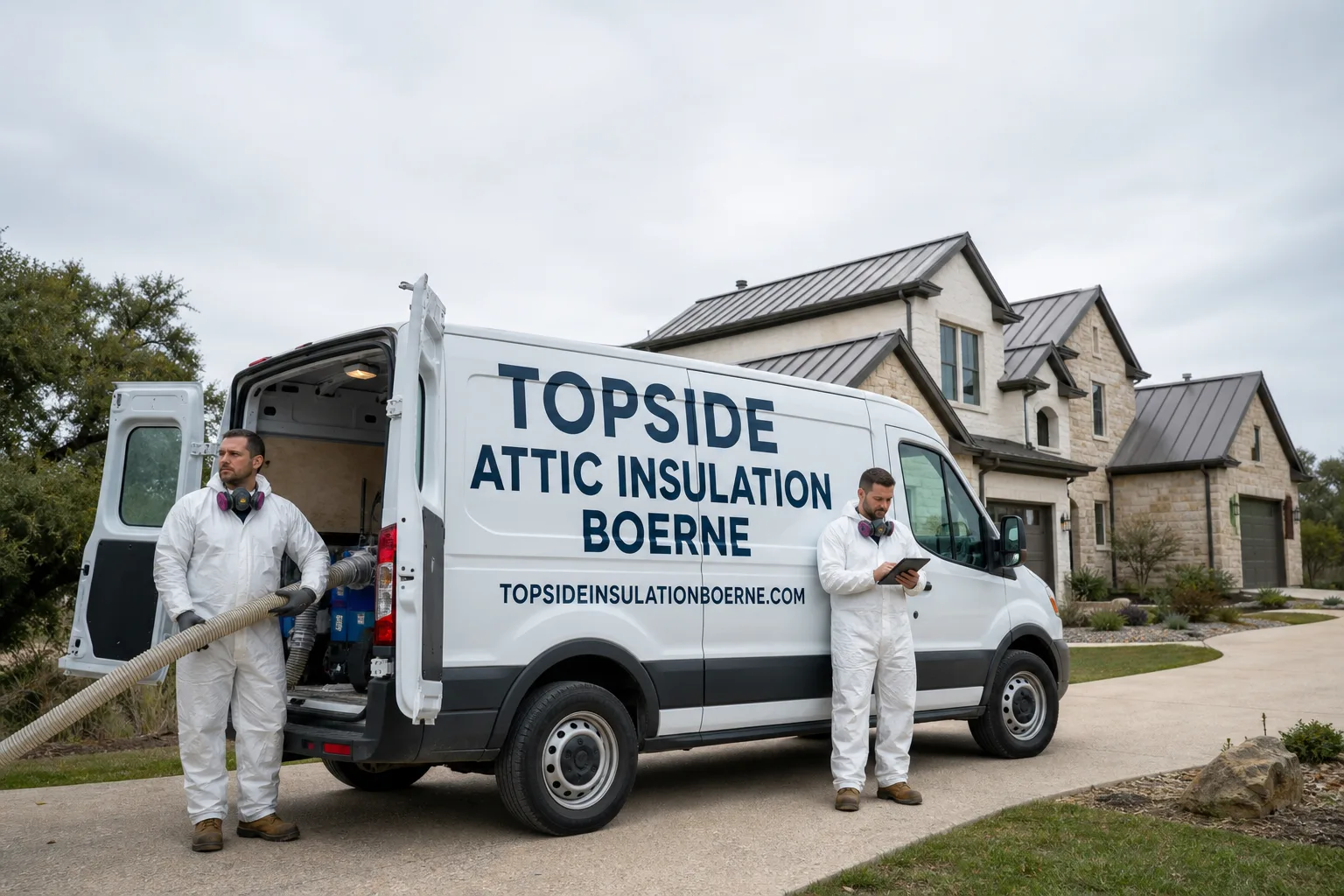
Trusted Blown-In Insulation for Boerne Homeowners
Most Boerne homes built between 1995 and 2015 were insulated to the minimum code of their year, not to what the Hill Country climate actually demands. Blown-In Insulation in Boerne fills gaps and levels uneven coverage in attics and walls, and in this area’s combination of hundred-degree summers and sudden winter cold snaps, that coverage gap is where your conditioned air escapes and your utility bills climb. We’ve insulated more than 9,000 homes since 2016, and in Boerne specifically, we regularly see attics with original fiberglass batts compressed to half their labeled R-value from years of storage traffic and ductwork maintenance.
Topside Attic Insulation Boerne operates under The Haven Standard: a written price before any work starts, a documented photo record when we leave, and on every air-sealing job, before-and-after blower-door numbers so you can verify the performance change. We’re independently owned and operated, and a live person answers our phones at (830) 529-7780 - no voicemail loops, no callback windows measured in business days.
What Our Blown-In Insulation Service Includes
Blown-In Cellulose
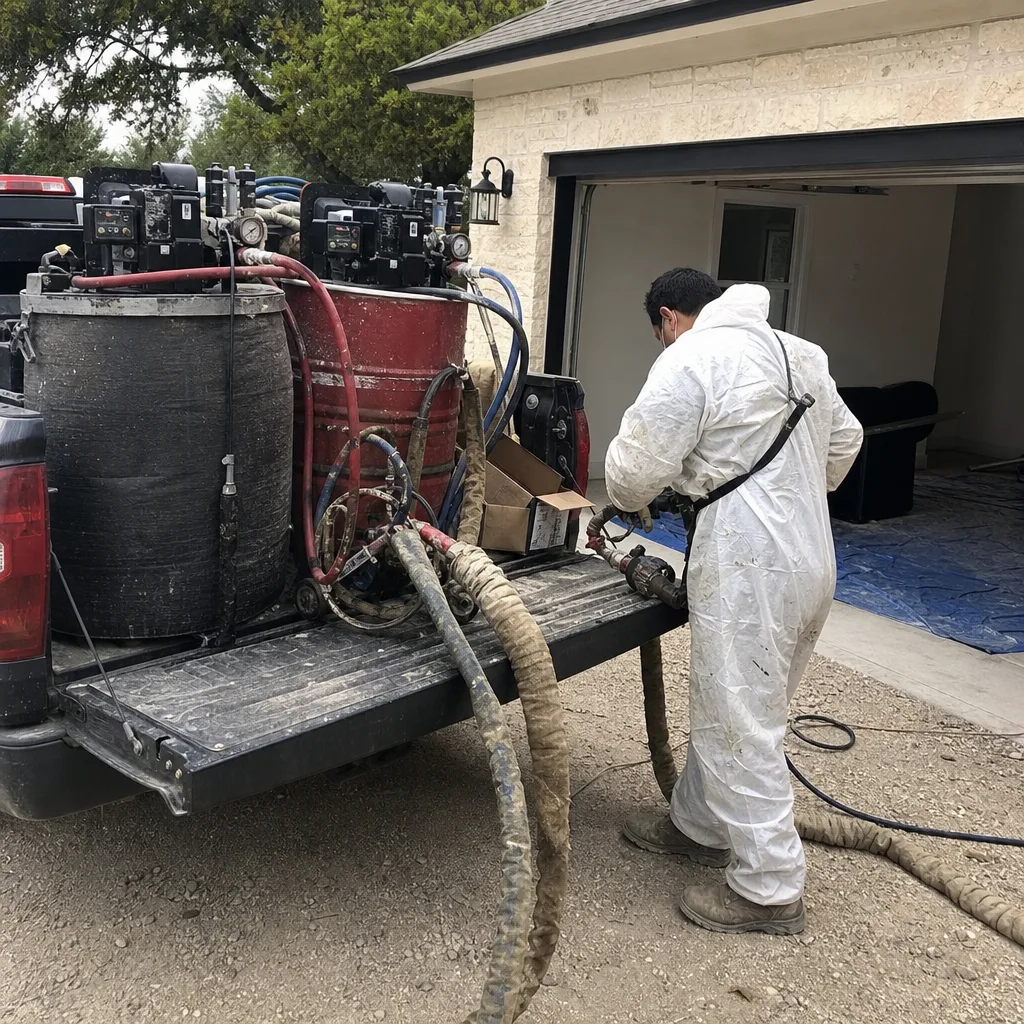
Cellulose is ground paper fiber treated with borate fire retardant, and we blow it dry into open attics or dense-pack it into closed wall cavities. In Boerne, cellulose performs well against our summer heat because it has slightly higher R-value per inch than standard fiberglass and fills irregular joist bays more completely around wiring and plumbing stacks. We source cellulose from GreenFiber and Owens Corning, and we never blow it over an unsealed attic floor - top plates, can lights, and penetrations get sealed first so the insulation isn’t filtering conditioned air into the attic for the next decade.
Blown-In Fiberglass
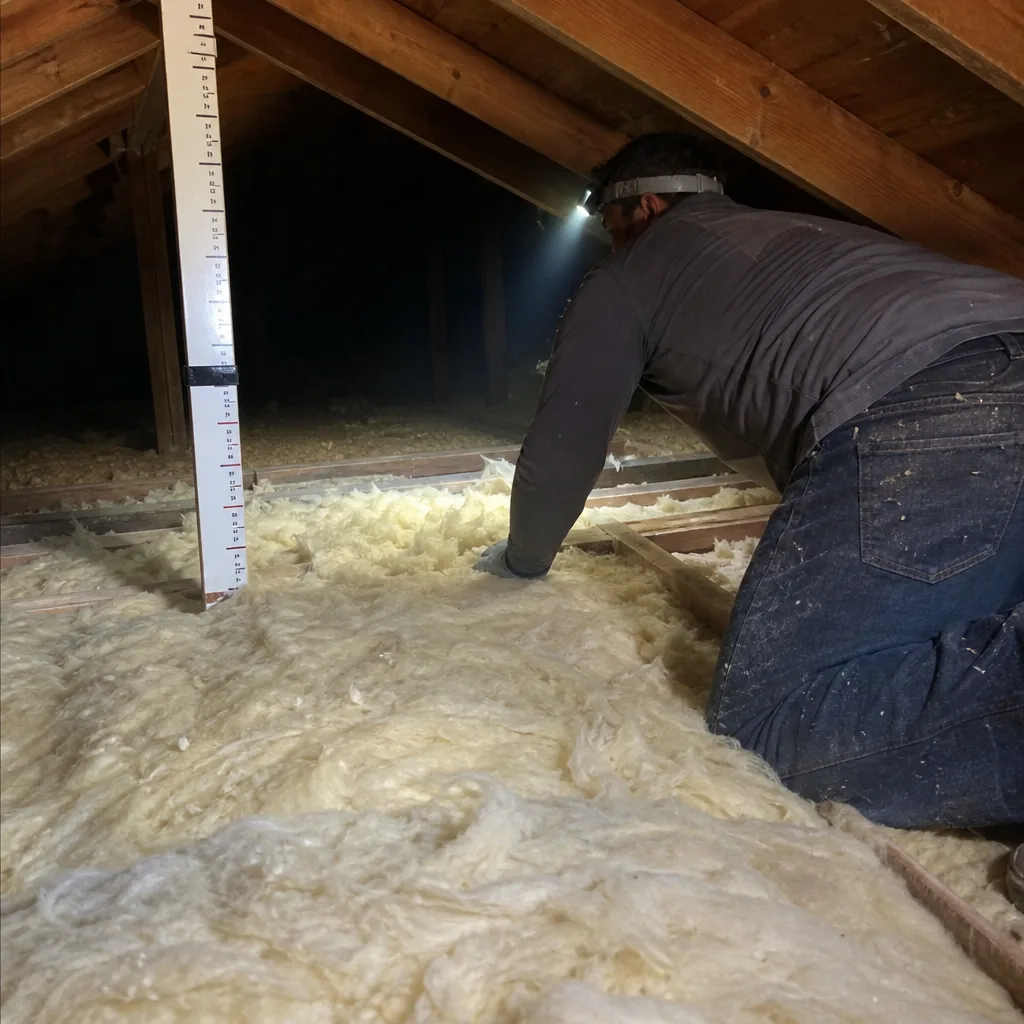
Fiberglass loose-fill is spun glass fiber, lighter than cellulose and better suited to attics with weight-sensitive structures or where homeowners want minimal compression over time. We see a lot of fiberglass in newer Boerne subdivisions like Esperanza and Cordillera Ranch, where builders used it for initial coverage but often stopped at R-30 or R-38 - below what the 2021 IECC recommends for this climate zone. We blow Owens Corning fiberglass to proper depth, mark the finished level with depth rulers, and document the coverage with photos you receive before we leave.
Dense-Pack Wall Insulation
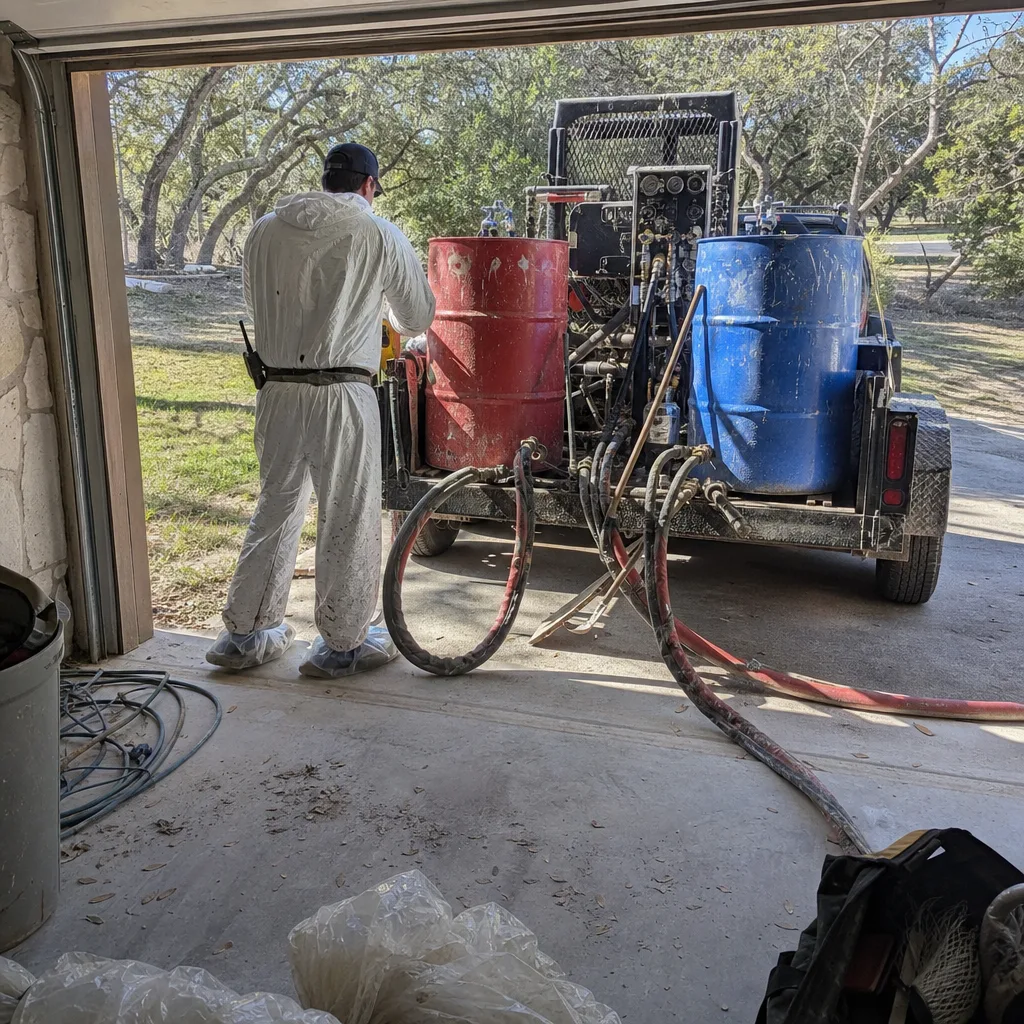
Dense-pack is blown-in cellulose or fiberglass installed at higher density into enclosed wall cavities, typically from the exterior through drilled holes or from the interior through access cuts. This is the right approach for Boerne homes with uninsulated 2×4 walls, common in pre-2000 construction in neighborhoods like Old Town Boerne and River Road. The material packs tight enough to resist settling and slow air movement through the cavity - we verify the density with a tube test during installation, and on jobs where we’re also air sealing, we provide blower-door numbers showing the reduction in air leakage.
Blown-In Top-Up
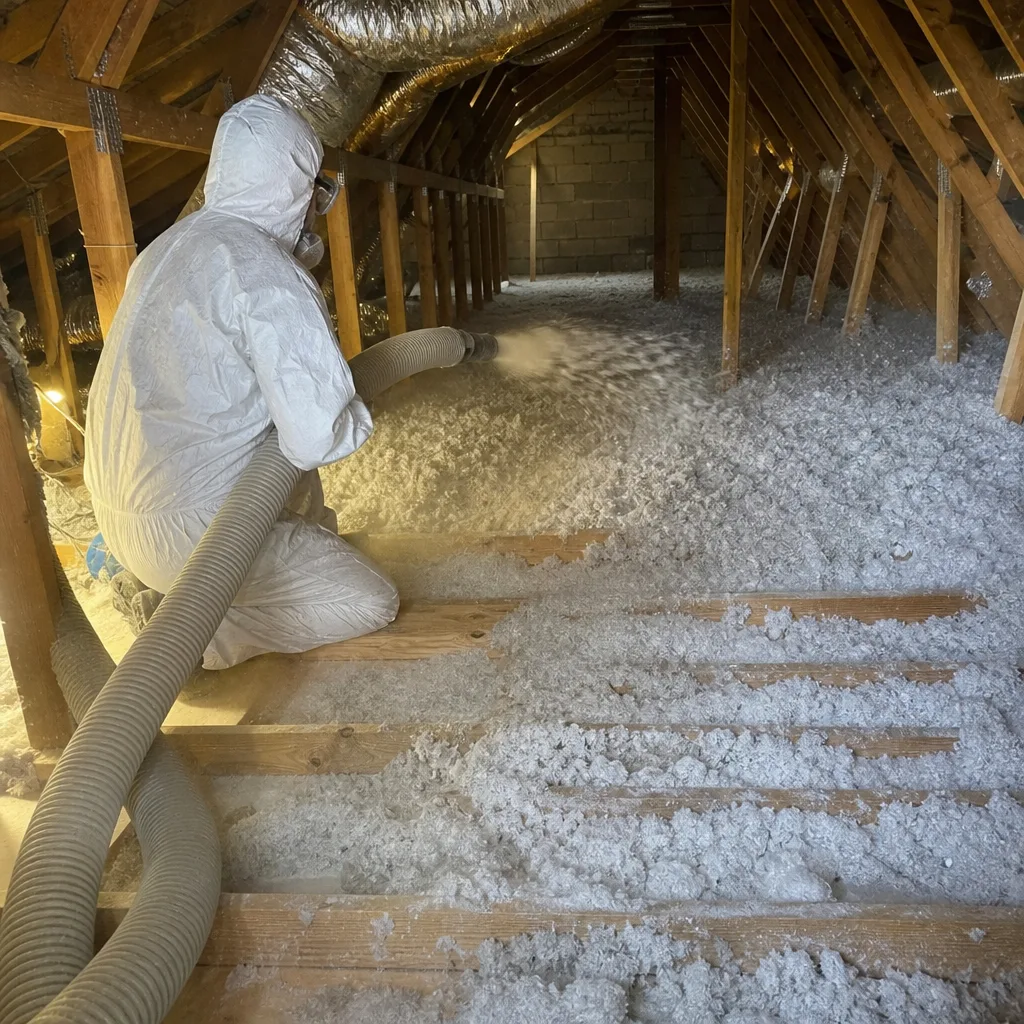
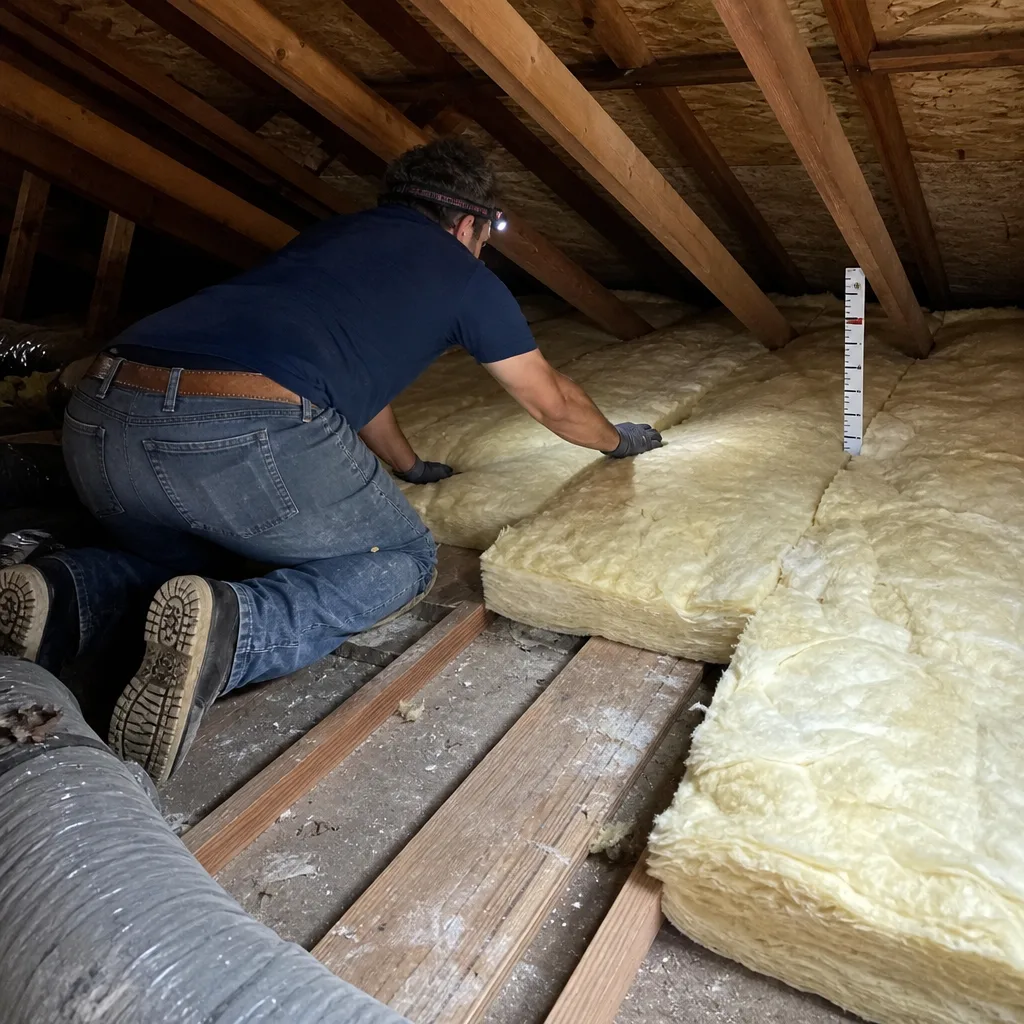
A top-up adds loose-fill material over existing insulation that has compressed, shifted, or was never deep enough to start with. In Boerne, we do a lot of top-ups in homes where the original insulation settled from R-38 to an effective R-25 or lower, especially in attics with frequent ductwork access. We inspect the existing layer first - wet, moldy, or rodent-compromised insulation gets removed, not covered - then seal air leaks and blow new material to the depth and R-value you need. The photo record shows the before condition, the sealed penetrations, and the finished depth with a measuring tape in frame.
What happens when you call
- 1
A real person answersNo phone trees - you reach a local pro.
- 2
You get an upfront price rangeHonest numbers before anyone is dispatched.
- 3
A background-checked tech heads outLicensed & insured, dispatched right away.
- 4
You approve before work beginsNothing starts until you say go.
Brands We Service for Blown-In Insulation
We work with the major blown-in insulation manufacturers regularly. Owens Corning fiberglass loose-fill is what we specify most often for Boerne attics - we’ve handled thousands of bags of their L77 product and know the coverage charts by wall cavity depth and net free area. GreenFiber cellulose is our go-to for dense-pack wall jobs and for homeowners who prefer a recycled-content material; we’ve installed it in hundreds of Hill Country homes and can show you the settled-density test results from recent jobs if you want to verify our installation quality.
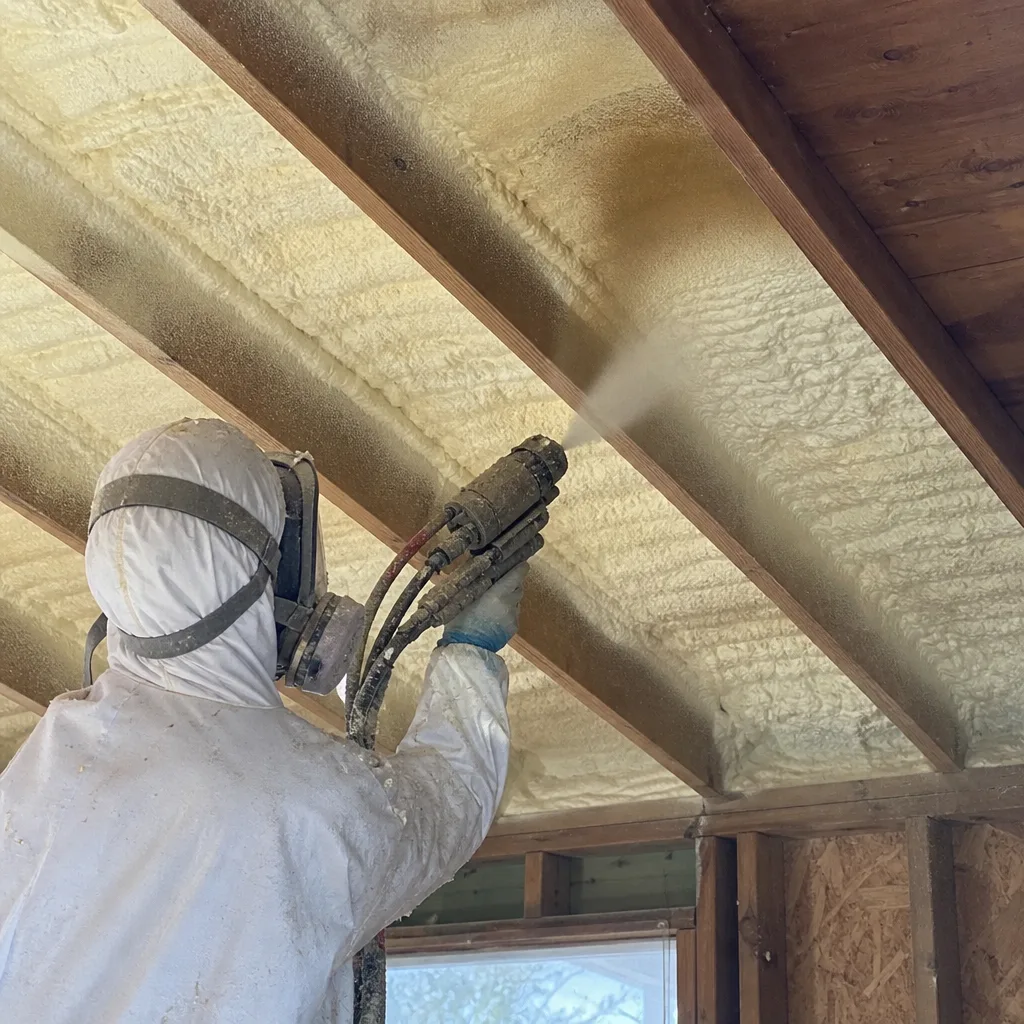
We also source from Johns Manville, Knauf, and Rockwool for specific applications, and from Icynene and Demilec when a project calls for hybrid spray foam and blown-in systems. We don’t have exclusive arrangements with any manufacturer - we specify what performs for your specific assembly, not what moves a volume rebate. Whether you have a preference for Owens Corning, GreenFiber, or any other make, we can install to the manufacturer’s specifications and provide the documentation to back it up.
Signs You Need Blown-In Insulation Right Now
- Your upstairs rooms run 8-12 degrees hotter than downstairs in July. In Boerne, this is often the first symptom homeowners notice. Heat radiates through an underinsulated attic ceiling faster than your HVAC can compensate, and the temperature split worsens as outdoor humidity drops and radiant gain increases. We measure attic floor insulation depth and check for thermal bypasses at the same time.
- Your energy bill spikes every August and January. Seasonal spikes that track with extreme temperatures, not with rate changes, point to an envelope problem. We’ve seen Boerne homeowners cut summer cooling costs by 20-35% after proper attic air sealing and blown-in insulation to current code levels.
- You can see the ceiling joists in your attic. Insulation should cover joists completely in a uniform layer. Visible joists mean inadequate depth, and in many Boerne homes, it also means the original batts were never lifted to add a second layer when codes changed. We document the existing depth with photos and a measuring tape before recommending a top-up or full replacement.
- Your attic has been used for storage or ductwork repairs. Every footstep compresses fiberglass batts and displaces loose fill. Compressed insulation loses R-value permanently - a batt compressed to half its thickness performs at roughly half its labeled rating. We see this constantly in Boerne attics where HVAC contractors have walked the same path to air handlers for years.
- You’re finishing a room over the garage or adding conditioned space. Garage ceiling assemblies in Boerne are often completely uninsulated or have a thin layer of batt that doesn’t meet the thermal boundary requirement for conditioned space. Blown-in dense-pack or loose-fill is the most practical way to insulate these irregular cavities without tearing down finished drywall.
Our Blown-In Insulation Process - Step by Step
- 1
Site evaluation and blower-door test. We start with a visual inspection of your attic or wall cavities and, on jobs involving air sealing, run a blower-door test - a pressurization reading that shows, in one number, how much air your building envelope is losing. In Boerne, a typical pre-2000 home reads 3,500-5,500 CFM50; post-2005 builds often read 2,500-4,000. We record this baseline and explain what it means for your specific floor plan.
- 2
Written price and scope. Under Haven Standard Clause 1, you get a flat price, written scope, and written warranty before anyone lifts a tool. No work starts without it. The scope specifies material type, target R-value, air-sealing details if applicable, and what documentation you’ll receive. If you have a competing quote, bring it - we offer a free second opinion and will read it with you line by line.
- 3
Air sealing before insulation. On attic jobs, we seal top plates, electrical penetrations, can light housings, bath fan boots, and chimney chases with fire-rated caulk, foam, or metal flashing as code requires. This happens before any insulation goes in. We’ve found that skipping this step, which some contractors do to hit a lower price point, leaves you with a filter - not a thermal boundary - because conditioned air still leaks through the insulation layer.
- 4
Installation with density and depth verification. We blow cellulose or fiberglass to the specified depth, installing depth rulers every 300 square feet so the finished coverage is verifiable. On dense-pack wall jobs, we test cavity fill with a tube density gauge. The crew lead photographs the work in progress and the finished condition; these photos become part of your documented photo record.
- 5
Final test, cleanup, and documentation. On air-sealing jobs, we run a second blower-door test and give you the before-and-after numbers. We clean the work area, remove all debris, and deliver your documentation: written scope as-completed, photo record, warranty terms, and if applicable, the blower-door report. This is standard on every job - not available on request, not an upgrade.
How Much Does Blown-In Insulation Cost in Boerne?
Most Blown-In Insulation pricing for Boerne attics runs between $1,800 and $4,200 depending on square footage, existing insulation condition, and whether air sealing is included. A typical 2,400-square-foot home with an attic around 1,200 square feet of floor area, needing a cellulose top-up from R-30 to R-49 with basic air sealing of top plates and penetrations, usually falls in the $2,400-$3,200 range. Dense-pack wall insulation for a single room addition or garage ceiling runs $2,800-$5,500 depending on cavity accessibility and whether interior or exterior access is needed.
What moves the price: attic accessibility (scuttle vs. pull-down stairs vs. no access), existing insulation that must be removed rather than topped, the presence of active roof leaks or rodent damage requiring remediation first, and whether HVAC ductwork in the attic needs to be raised and sealed before insulation goes over it. We see a lot of Boerne homes with flex duct lying directly on the attic floor - code now requires it to be suspended above the insulation layer, which adds labor but prevents compression and condensation.
How to avoid overpaying: get a written scope that specifies material brand, target R-value, and whether air sealing is included or excluded. A quote that only says “blow in insulation to R-38” without naming the material or sealing details leaves room for substitution and corner-cutting. Our written price includes all of this before any work starts, and our free second opinion service lets you test any competing quote against a detailed scope.
What’s included in our free estimate: attic or wall cavity inspection, insulation depth measurement, moisture and mold check, photos of conditions we find, and a written price with flat fee - not a range that expands once we’re in the attic. Call (830) 529-7780 to schedule; estimates are free and no-obligation.
Blown-In Insulation Near Boerne - Our Service Area
We work throughout the Hill Country corridor surrounding Boerne, with typical drive times of 15-35 minutes to Fair Oaks Ranch, Scenic Oaks, Helotes, Timberwood Park, and Bulverde. Lakehills and Leon Valley are within our regular service radius, and we handle jobs in Alamo Heights, Terrell Hills, and Castle Hills when they involve the full building-envelope scope we specialize in. San Antonio metro projects are evaluated case by case - we take them when the work matches our air-sealing-first approach. Most Boerne-area estimates are scheduled within 48 hours of your call, and a live person answers the phone 24/7.
Serving Boerne, TX - Our Local Coverage Area
We’re based in the Boerne area and know this community well, and we also provide our Blown-In Insulation in Helotes. Use the map below to see our service coverage - if you’re nearby, we can almost certainly help.
Frequently Asked Questions - Blown-In Insulation in Boerne
Blown-In Insulation in Bulverde is the same loose-fill cellulose or fiberglass that a crew blows into place with a hose and blower, allowing it to fill irregular cavities and cover joists completely rather than fitting between them like batt insulation. In Boerne attics, this matters because batts leave gaps around wiring, plumbing stacks, and framing irregularities that loose fill seals naturally. We regularly find batts installed with 10-15% gaps by area, which translates directly to thermal bypass and higher bills.
A typical Boerne attic top-up or fresh installation takes one day for a crew of two; dense-pack wall jobs or full removals with air sealing usually run two days. We schedule arrival windows, not all-day waits - under Haven Standard: Arrive on schedule, you get a named technician and a text when they are on the way. The crew lead reviews the written scope with you before starting and again at final walkthrough.
Most jobs run $1,800-$4,200 for attics and $2,800-$5,500 for dense-pack walls, with the final price depending on square footage, material choice, and whether existing insulation needs removal. We publish a written price before any work starts - no surprises, no mid-job additions. Call (830) 529-7780 for an exact quote on your specific home; estimates are free.
Yes - we install Owens Corning fiberglass loose-fill and GreenFiber cellulose regularly, and we stock both for standard Boerne jobs. We also work with Johns Manville, Knauf, and Rockwool when the application calls for it. We don’t push proprietary products or exclusive brands; we specify what performs for your assembly and document the installation to manufacturer standards.
We don’t treat insulation as an emergency trade - it’s scheduled work that requires proper evaluation and material staging. That said, a live person answers our phones 24/7, and if you’re dealing with an urgent situation like a roof leak that has saturated insulation or a failed HVAC system revealing extreme attic heat gain, we’ll get a technician to evaluate within 24 hours and can often schedule the repair or replacement within a few days. Call (830) 529-7780 anytime.
All completed work is covered by our 365-Day Done Right Promise - if it’s not done right, we make it right. The specific warranty terms are written and delivered before work starts, not after. For materials, Owens Corning and GreenFiber carry their own manufacturer warranties against defect, which we pass through to you with the documentation needed to make any claim. The photo record and blower-door report we provide support both our workmanship warranty and any future material claim.
Clear attic storage items from the work area and ensure we have clear path access from our truck to the attic entry. If we’re doing interior dense-pack wall work, move furniture 3 feet from exterior walls and remove wall hangings. We’ll cover floors and protect your space during work; the documented photo record includes condition photos taken before we start. The crew lead will walk through these details with you at scheduling and again on arrival.
Schedule Your Blown-In Insulation Service in Boerne Today
Call (830) 529-7780 to schedule your free estimate. A live person will answer, gather the details of your home and concerns, and book a time that works for your schedule. You’ll receive a written price before any work starts, a documented photo record when the crew leaves, and on air-sealing jobs, before-and-after blower-door numbers that prove the performance change. That’s The Haven Standard, and it’s how we’ve operated since 2016.
Written by Wes Okafor, Owner at Topside Attic Insulation Boerne, serving Boerne and the Hill Country since 2016.