
Last updated September 24, 2026
The Complete Guide to Insulation in Boerne
Boerne sits at 1,395 feet above sea level with caliche-heavy soil and temperature swings that routinely hit 40°F in a single day. The statewide default of R-38 attic insulation was calibrated for Houston’s muggy, flat terrain, not for Hill Country conditions where summer attic temperatures push 140°F and winter cold snaps radiate through walls faster than the labeled R-value suggests. In this guide, we’ll walk through what actually performs here: how elevation changes vapor drive, why air sealing must precede insulation, what the numbers on a blower-door report mean for your utility bill, and how to read a contractor’s bid against documented performance instead of promises. For more guides & resources on Boerne home performance, see our blog.
Quick Answer
Insulation in Boerne requires matching three variables to Hill Country conditions: R-value appropriate for 1,395-foot elevation and 140°F summer attics, air sealing completed before any insulation is installed, and vapor management sized for caliche soil rather than coastal humidity. Most complete attic retrofits in Boerne run $3,800-$7,200 for air sealing plus blown-in insulation to R-49, with spray foam applications ranging $5,500-$12,000 depending on assembly depth and accessibility. See our Insulation Cost Breakdown: The Boerne Homeowner’s Reference for 2026 for detailed pricing factors.
Table of Contents
- Why Boerne’s Climate Breaks Statewide Insulation Assumptions
- R-Value, Settling, and What Five Hill Country Summers Actually Do
- Air Sealing First: The Blower-Door Number That Predicts Everything
- Attic Insulation Options for Boerne Homes
- Wall Insulation and the Thermal Bridging Problem
- Crawl Space Encapsulation and Vapor Barriers on Caliche Soil
- When Radiant Barriers Help and When They Don’t
- What Proper Documentation Looks Like
Why Boerne’s Climate Breaks Statewide Insulation Assumptions
Texas energy code tables treat the state as three zones: humid coastal, mixed central, and dry west. Boerne falls into the mixed zone, but its specific conditions create a dual-season loading problem that standard recommendations miss.
Summer attic temperatures in Boerne regularly reach 135-145°F. At 1,395 feet, air density is lower than Houston’s, which changes convective heat transfer rates. The 40°F daily temperature swing, common from October through April, creates repeated expansion and contraction cycles in framing and insulation materials. And the caliche soil beneath Boerne homes, a cement-like calcium carbonate layer, behaves differently than gulf coast clay: it wicks moisture laterally rather than draining vertically, which alters crawl space vapor drive in ways that standard 6-mil polyethylene barriers don’t address.
We’ve measured attic conditions in Boerne neighborhoods from The Heights to Fair Oaks Ranch. The pattern holds: homes built 2005-2015 with R-38 blown fiberglass are running 18-22°F hotter at the ceiling plane than similarly insulated homes in San Antonio proper. The difference is elevation plus exposure. Boerne’s Hill Country ridgelines catch wind, but they also catch sun, and attic ventilation rates designed for lower, shadier lots don’t keep pace.
What this means practically: R-38 in a Boerne attic performs like R-32 in a Houston attic during peak summer, and like R-30 during a January cold snap when radiative cooling strips heat through the roof assembly overnight. The IECC 2021 recommendation for Climate Zone 2, R-38 to R-49, should be read as a floor in Boerne, not a target. We specify R-49 minimum for attics and design wall assemblies that account for thermal bridging rather than trusting cavity R-value alone.
R-Value, Settling, and What Five Hill Country Summers Actually Do
R-value is tested in a lab at 75°F with no airflow. Your attic in Boerne in August is not a lab. Here’s how three common materials perform after real-world exposure.
| Material | Installed R-value per inch | 5-year settled R-value in Boerne attic | Primary failure mode |
|---|---|---|---|
| Blown fiberglass (Knauf Jet Stream) | R-2.5 to R-3.0 | 85-90% of original | Convective looping in deep cavities; minimal settling |
| Blown cellulose (GreenFiber) | R-3.2 to R-3.8 | 75-82% of original | Settlement 10-15%; fire retardant degradation at 140°F+ |
| Open-cell spray foam (Icynene MD-C-200) | R-3.6 to R-3.9 | 95-98% of original | None significant; air-sealing value retained |
The cellulose numbers deserve attention. Cellulose performs well year one. But the boric acid fire retardant in most blown cellulose begins degrading with repeated heat cycling above 130°F. After five Boerne summers, we’ve pulled samples that lost 8-12% of original density through thermal drift, not just physical settling. The R-value drop follows. This doesn’t make cellulose a bad choice, but it means the installed depth needs to account for performance decay, not just initial coverage.
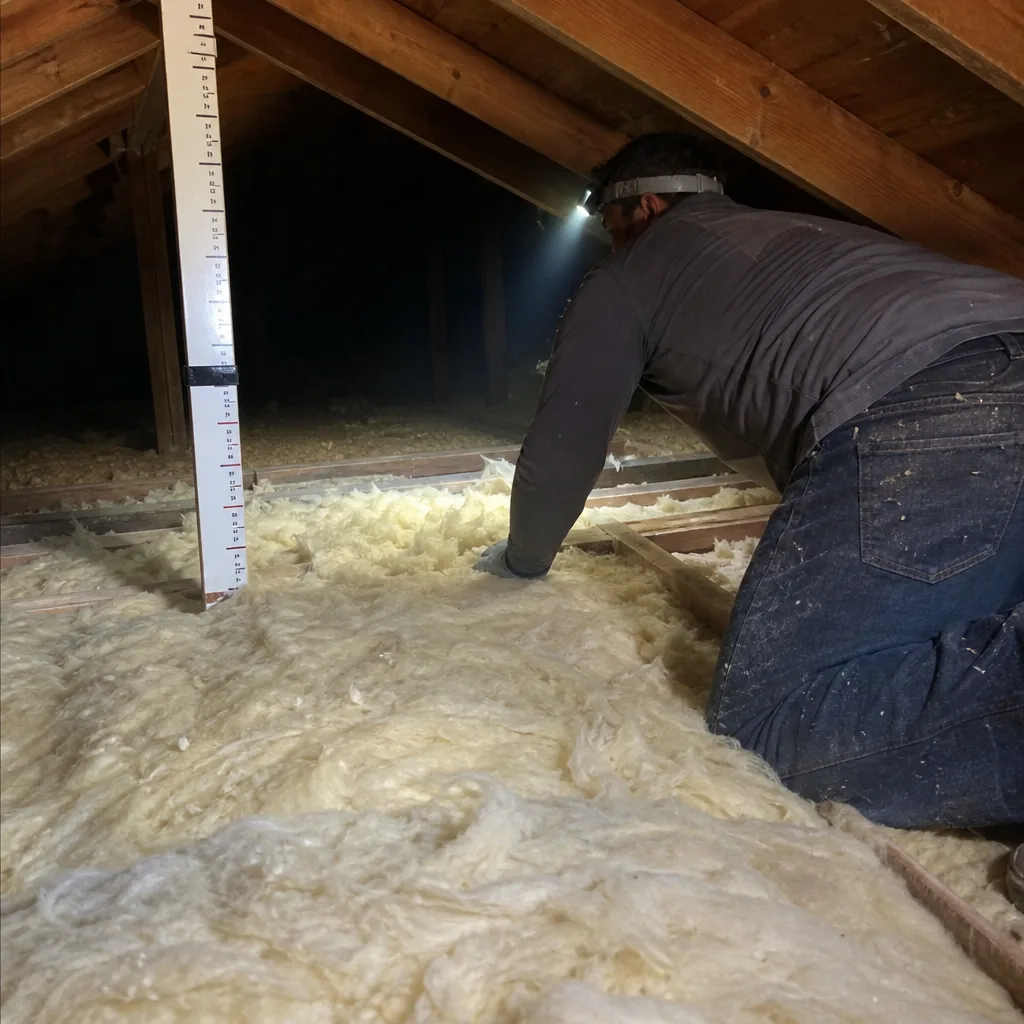
Blown fiberglass, by contrast, doesn’t settle much but can convect. In deep attic cavities, temperature differentials create air currents within the insulation itself, effectively bypassing the material. The fix is density: installing to manufacturer-specified pounds per square foot, verified with a depth ruler in multiple locations. We document this on every job with installation photos showing depth markers against framing.
Open-cell spray foam, when applied to proper thickness (typically 5.5 inches for R-21 walls, 6-7 inches for R-24+ roofs), maintains its performance because it’s adhered to the substrate. No convection, no settling. The tradeoff is cost and the need for precise application, vapor-permeable or vapor-impermeable depending on assembly position.
For Boerne homes, our specification depends on the assembly. Attic floors get blown fiberglass to R-49 at specified density, with air sealing completed first. Cathedral ceilings and conditioned attics get open-cell spray foam, with vapor profile calculated for the specific roof deck. We don’t default to one material; we match it to the loading condition.
Air Sealing First: The Blower-Door Number That Predicts Everything
We won’t blow insulation over an unsealed attic floor. That’s not a preference; it’s physics. Air moving through insulation strips its effective R-value by 30-50%, regardless of the material. A home with R-49 fiberglass and 3,000 CFM50 of leakage performs like a home with R-25 and proper sealing.
The blower-door test, a pressurization reading that shows in one number how much air your building envelope is losing, is the diagnostic tool that makes this visible. Here’s what the numbers mean for Boerne:
| ACH50 (air changes per hour at 50 pascals) | Condition | Typical pre-retrofit Boerne home |
|---|---|---|
| 15+ ACH50 | Very leaky, pre-1990 construction common | 15-20% of homes we test |
| 10-15 ACH50 | Leaky, 1990-2010 construction with minimal sealing | 45-50% of homes we test |
| 7-10 ACH50 | Moderate, some code-compliant sealing | 25-30% of homes we test |
| 5-7 ACH50 | Tight, good practice or recent construction | 5-10% of homes we test |
| 3-5 ACH50 | Very tight, passive house territory | Rare without targeted retrofit |
IECC 2021 targets 5 ACH50 for new construction in Climate Zone 2. Most Boerne homes we test pre-retrofit score 10-15 ACH50. Our post-retrofit target is 5-7 ACH50 for existing homes, which is achievable without specialized construction and delivers measurable utility reduction.
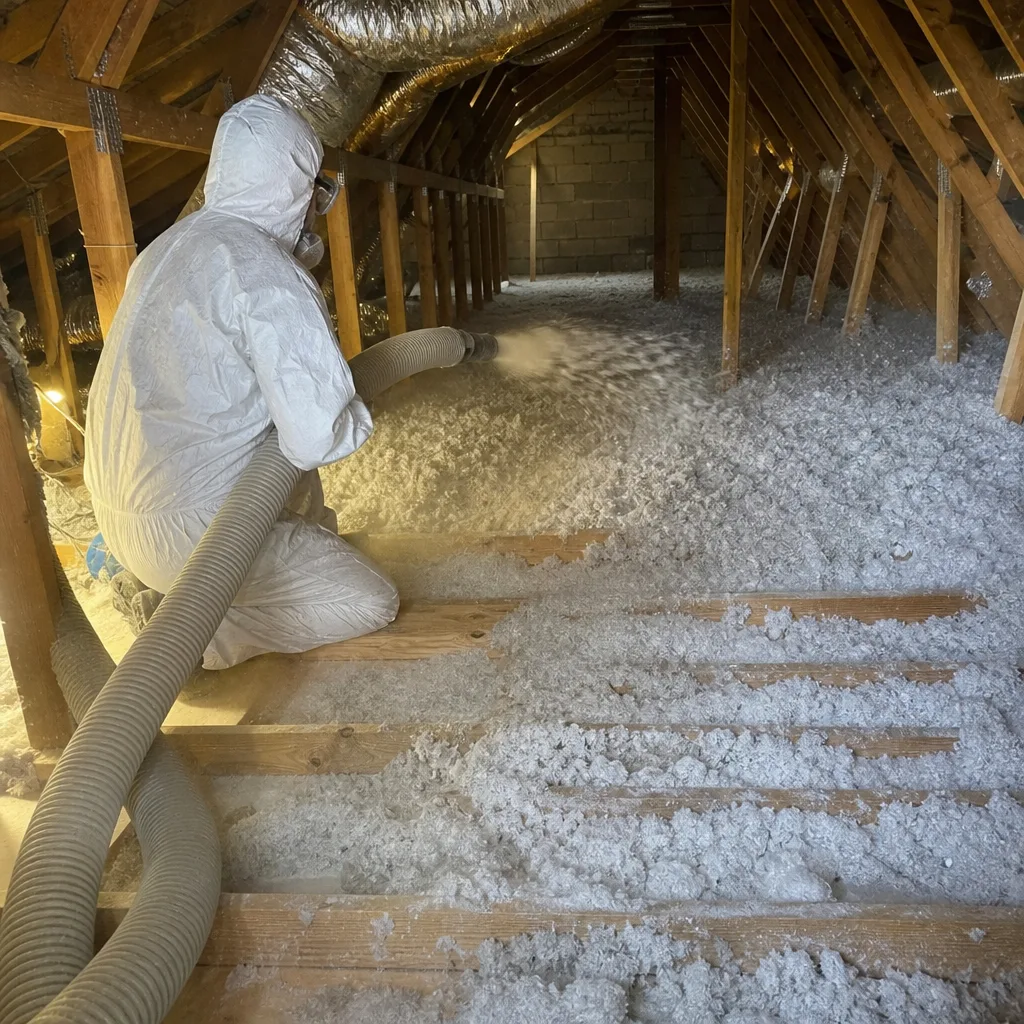
The sealing process is specific. We start at the attic floor: top plates where interior walls meet the ceiling, electrical and plumbing penetrations, can light housings, chimney chases, and duct boots. Each gets sealed with appropriate material: fire-rated caulk for penetrations, rigid foam and tape for large gaps, weatherstripped dams for access hatches. Then we test again. The blower-door number tells us whether we missed something.
On every applicable job, we provide before-and-after blower-door readings. A typical Boerne retrofit might read 4,200 CFM50 before sealing and 2,100 after, with corresponding ACH50 dropping from 12 to 6. The homeowner gets this in writing, with the test date, outdoor temperature, and technician signature. It’s documentation that the work performed as specified, not a promise that it should.
Attic Insulation Options for Boerne Homes
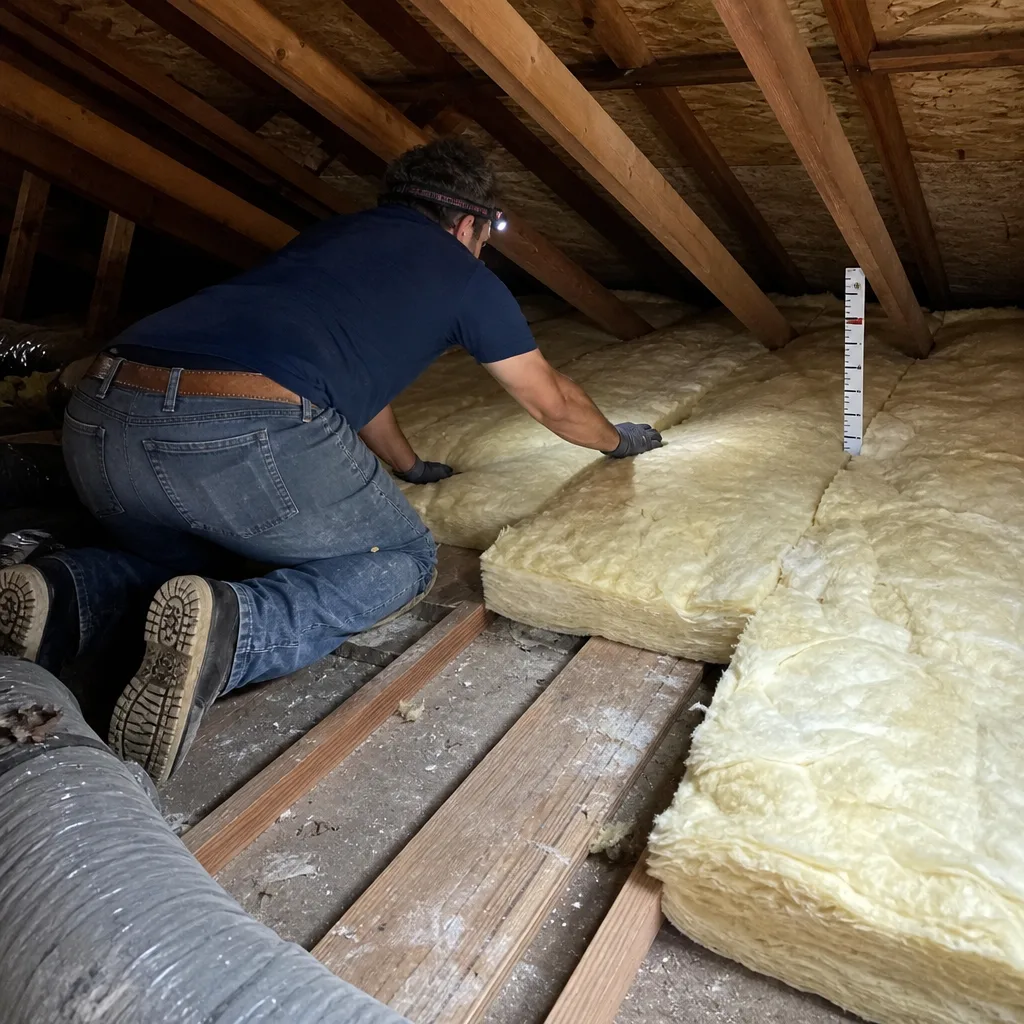
The attic is where Boerne’s climate loads hardest, and where insulation choices matter most. We break this into two assembly types: vented attics with insulation at the floor, and conditioned attics with insulation at the roofline.
Vented Attic, Floor Insulation
This is the most common existing condition in Boerne homes built 1980-2010. The attic is vented at soffit and ridge, and insulation sits on the ceiling plane. For this assembly:
- Air seal the attic floor completely before adding insulation. Top plates, penetrations, can lights, chimney chases, duct boots.
- Install baffles at every soffit vent to maintain airflow over the insulation and prevent wind washing.
- Install blown fiberglass or cellulose to R-49 minimum, verified with depth rulers at multiple locations.
- Document installed depth and density with photos showing depth markers against framing members.
Material choice: We typically specify Knauf Jet Stream blown fiberglass for vented attics in Boerne. The lower settling rate matters in a climate with repeated thermal cycling, and the material maintains performance at the temperature extremes this attic sees. Cellulose is viable but requires 15-20% overblow to account for long-term degradation.
Cost range for a complete vented attic retrofit in Boerne: air sealing plus blown insulation to R-49 typically runs $3,800-$5,500 for homes under 2,500 square feet, and $5,200-$7,200 for larger homes or those with complex rooflines and multiple HVAC zones.
Conditioned Attic, Roofline Insulation
When the attic contains HVAC equipment or ductwork, or when the homeowner wants storage space, we insulate at the roofline. This converts the attic to conditioned space, which eliminates the thermal penalty of ducts running through 140°F ambient air.
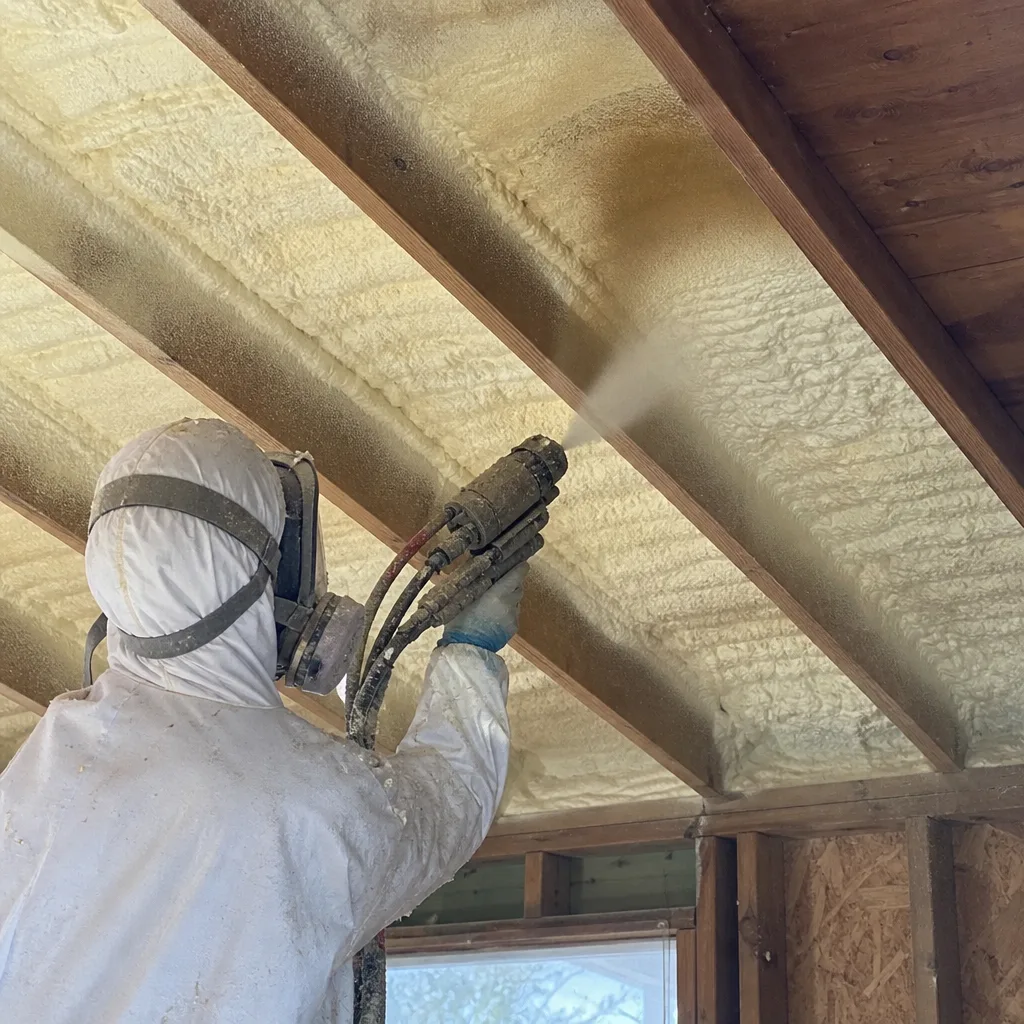
For this assembly, we specify open-cell spray foam applied directly to the roof deck underside, typically 6-7 inches for R-24 to R-26. The foam creates both insulation and air barrier in one application. Critical detail: the roof deck must be able to dry inward, which means no interior vapor barrier. Open-cell foam is vapor-permeable; closed-cell is not. In Boerne’s mixed-humidity climate, closed-cell at the roofline can trap moisture if the deck leaks.
Cost range for conditioned attic conversion: $5,500-$9,000 for simple gable roofs under 2,500 square feet, and $8,500-$12,000 for complex roofs with dormers, valleys, or existing HVAC relocation needs.
Attic Insulation in Boerne covers assembly-specific details in more depth.
Wall Insulation and the Thermal Bridging Problem
Boerne’s common construction, 2×4 framing at 16 inches on center with R-13 fiberglass batts, has a whole-wall R-value 15-20% below the labeled cavity R-value. The reason is thermal bridging: every stud, plate, and header is a direct path for heat to bypass the insulation.
Here’s the math. A 2×4 stud has R-value of approximately 4.4. The R-13 batt in the cavity averages with the stud path. For a standard 16-inch o.c. wall with 15% framing factor, the whole-wall R-value is roughly R-11, not R-13. Add sheathing, siding, and interior finish, and the assembly might reach R-12.5 effective. In a January cold snap with 20°F overnight lows and radiative cooling, that difference matters.
The fix is continuous exterior insulation, which interrupts the thermal bridge. Options for Boerne:
- Rigid mineral wool (Rockwool Comfortboard 80) at 1.5 inches, R-6, installed over sheathing with rainscreen gap. Permeable, fire-resistant, handles Boerne’s temperature cycling without degradation.
- Polyiso foam at 1 inch, R-6, with foil facing. Higher R per inch but requires careful detailing at windows and doors to avoid moisture traps.
- Closed-cell spray foam at 2 inches on exterior sheathing, R-12+, typically in new construction or deep retrofit only.
For existing homes without exterior access, dense-pack cellulose or fiberglass in closed cavities can improve performance 10-15% over settled batts, but doesn’t solve the bridging problem. The honest assessment: if your walls are already closed, the return on wall insulation retrofit is lower than attic air sealing and insulation. We tell homeowners this directly, and direct budget accordingly.
Under Haven Standard: Have it in writing - we specify the expected performance improvement in the written scope, with the caveat that wall retrofits without continuous exterior insulation are limited by framing factor.
Crawl Space Encapsulation and Vapor Barriers on Caliche Soil
Boerne’s caliche soil, a hardened calcium carbonate layer that forms at 6-24 inches depth, creates a unique moisture dynamic. Unlike gulf coast clay, which swells and drains vertically, caliche is nearly impermeable. Water moves laterally along the caliche layer, then evaporates upward through the crawl space floor. Standard 6-mil polyethylene vapor barriers, sized for Houston’s downward vapor drive, often fail here because they’re not sealed to walls and piers, and because they’re not thick enough to withstand installation traffic.
We’ve pulled failed vapor barriers in Boerne crawl spaces - Fair Oaks Ranch, Balcones Creek, The Heights - where 6-mil poly was laid loose on the ground, stapled to piers, and torn within three years. The crawl space humidity stayed above 70% year-round, and floor insulation above absorbed moisture and collapsed.
Our specification for Boerne crawl spaces:
- Remove existing degraded insulation and debris.
- Grade and level the soil surface, addressing any standing water patterns first.
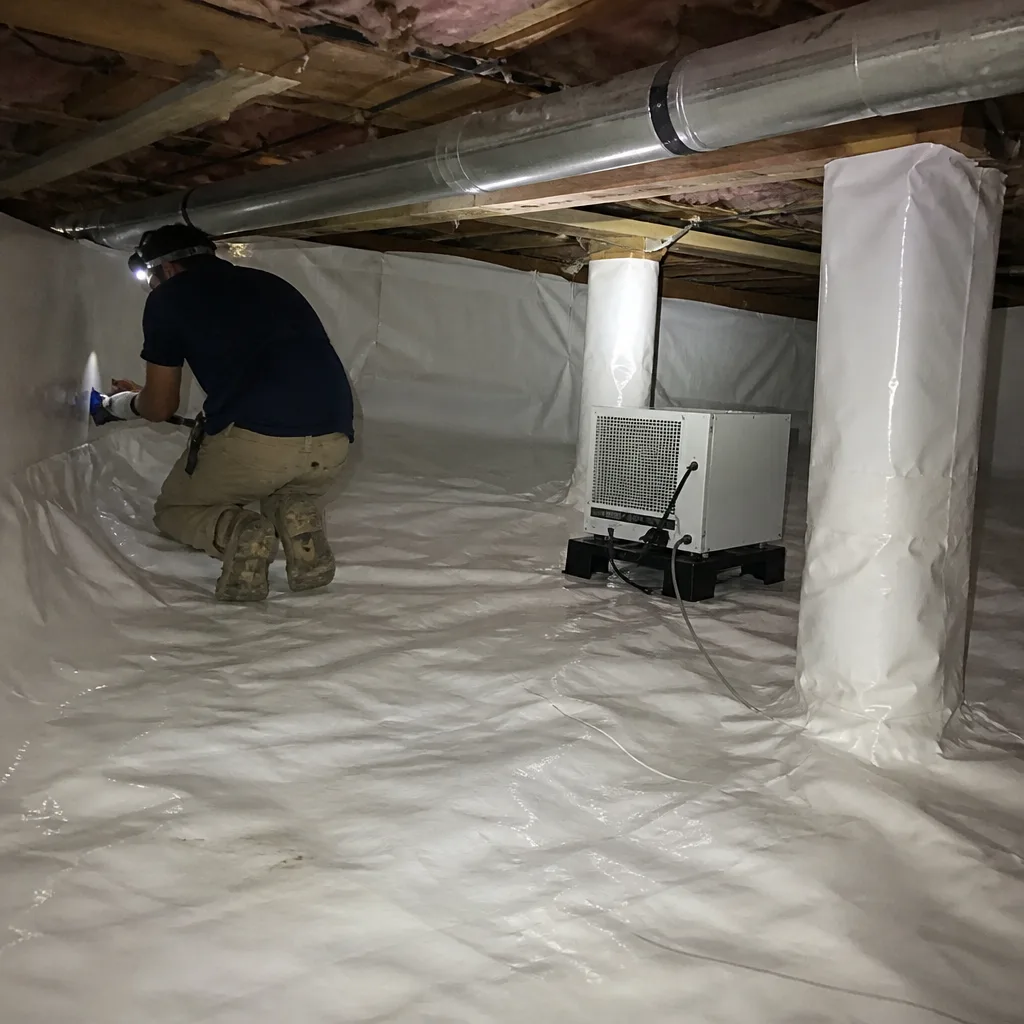
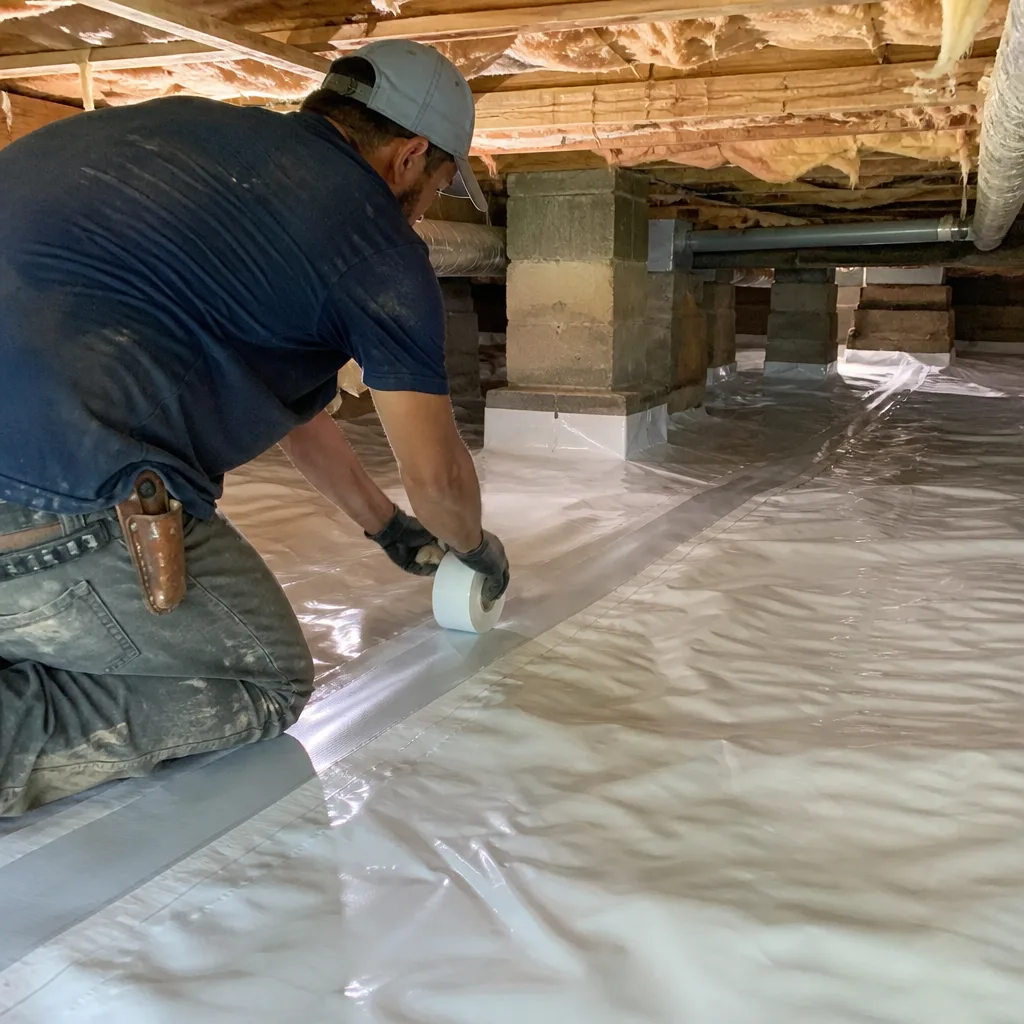
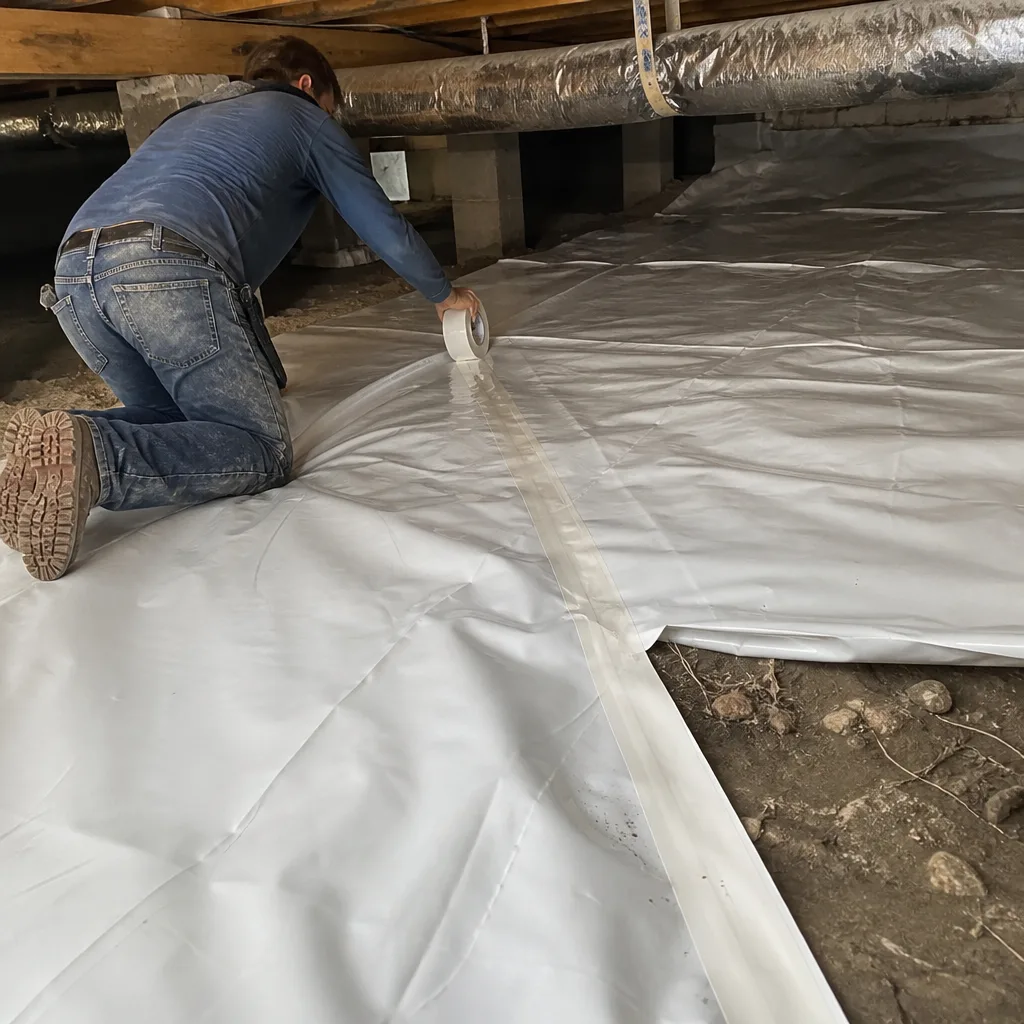
- Install 12-20 mil reinforced polyethylene vapor barrier, seams overlapped 12 inches and sealed with vapor-proof tape, extended 6 inches up walls and piers and sealed with mechanical fasteners and mastic.
- Seal foundation vents if converting to conditioned crawl space, or ensure adequate cross-ventilation if maintaining vented design.
- Install rigid foam insulation at crawl space walls (conditioned) or floor joist bays (vented), with ignition barrier where required by code.
- Install dehumidifier with condensate pump for conditioned crawl spaces, sized to the volume and Boerne’s specific humidity load.
The vapor barrier specification matters. We use reinforced 20-mil material, not standard 6-mil, because the caliche surface is abrasive and the installation requires traffic. The reinforcement grid prevents tears during placement and during future service access.
Cost range for complete crawl space encapsulation in Boerne: $4,500-$7,500 for typical 1,200-2,000 square foot crawl spaces, including vapor barrier, wall insulation, and dehumidifier. Vented crawl spaces with floor insulation only run $2,200-$3,800.
Crawl Space Encapsulation & Vapor Barrier in Boerne has additional detail on conditioned versus vented design.
When Radiant Barriers Help and When They Don’t
Radiant barriers, typically foil-faced products installed at the roof deck underside or as a decking overlay, reflect radiant heat rather than resist conductive flow. In Boerne’s 140°F attic conditions, the radiant load is significant, and barriers can reduce attic air temperature 20-30°F.
But the performance is situational:
- Helpful: Vented attics with significant ductwork in the attic space, where reducing radiant temperature reduces duct heat gain. Homes with dark shingle roofs that absorb more solar radiation. Homes where adding conventional insulation depth is constrained by access or structure.
- Not helpful: Conditioned attics, where the roof deck is already inside the thermal boundary. Homes with adequate insulation and good air sealing, where the marginal gain doesn’t justify cost. Homes with radiant barriers installed directly on top of insulation, where dust accumulation degrades performance within 2-3 years.
We install radiant barriers in Boerne, but only after blower-door testing confirms the air sealing is adequate. A leaky attic with a radiant barrier still loses conditioned air; the barrier addresses radiant gain, not convective loss. The proper sequence is seal, insulate, then evaluate whether radiant barrier adds sufficient value for the specific roof and duct configuration.
Typical radiant barrier installation in a Boerne vented attic: $1,800-$2,800 for staple-up foil at rafters, or $2,200-$3,500 for foil-faced roof decking in new construction or re-roof scenarios.
What Proper Documentation Looks Like
A contractor who can’t show you what you’ll receive is a contractor who hasn’t defined the work. Under Haven Standard, every job begins with a written price and ends with a documented record. Here’s what that package contains, and why its absence is a red flag.
Pre-Work Documentation
- Written scope of work with specific materials listed by manufacturer and product name, not generic descriptions like “blown insulation”
- Written price, itemized where multiple assemblies are involved
- Written warranty terms, including duration and what conditions void coverage
- Pre-work blower-door test report with CFM50, ACH50, outdoor conditions, and technician signature
- Pre-work photos of existing conditions, including any deficiencies that affect the scope
Post-Work Documentation
- Installation photos with depth rulers visible in multiple locations, showing installed thickness against framing
- Material spec sheets or bag labels photographed, confirming product and batch
- Post-work blower-door test report, with before/after comparison
- Invoice matching the written price, with any change orders documented and signed
- 365-Day Done Right Promise documentation, with contact method for warranty claims
We’ve reviewed competitor bids in Boerne that listed “insulate attic to code” with no material specification, no air sealing scope, and no test protocol. Homeowners weighing DIY vs Professional Insulation: The Boerne Homeowner’s Decision Guide should note these gaps. The homeowner has no basis to verify what was installed or whether it performed. The Haven Standard exists specifically to prevent this: Have it in writing, have it tested, have it documented.
Since 2016, we’ve sealed and insulated 9,000+ homes. Every one had a written price before work started and a documented record when the crew left. The photo record isn’t available on request; it’s included on every job, automatically, because it’s part of the work.
Common Mistakes to Avoid
- Installing insulation over unsealed attic floors. Air moving through fiberglass or cellulose strips 30-50% of its effective R-value. The insulation looks full; the performance isn’t there. Always seal first, test, then insulate.
- Specifying R-38 for Boerne attics. The statewide default underestimates Hill Country loading. R-49 minimum for vented attics, with verification that installed density matches specification.
- Using 6-mil vapor barriers on caliche soil. The abrasive surface and lateral moisture drive tear and undermine standard poly. Specify reinforced 12-20 mil with sealed seams and wall extensions.
- Trusting cavity R-value for whole-wall performance. A 2×4 wall with R-13 batts performs at R-11-R-12 effective due to thermal bridging. Continuous exterior insulation is the only fix for existing framed walls.
- Installing radiant barriers without air sealing first. Radiant barriers address heat gain, not air loss. A leaky attic with radiant foil still wastes conditioned air and money.
- Accepting bids without material specifications. “Blown fiberglass” could be R-2.2 per inch or R-3.0 per inch, virgin or recycled, with or without formaldehyde binder. The written scope must name the product.
- Skipping post-work verification. Without a blower-door test after sealing, you don’t know if the work performed. The number is the proof.
When to Call a Professional
Call when your summer upstairs temperatures stay 15°F above thermostat setpoint despite the AC running continuously. Call when you find insulation compressed, wet, or displaced in the attic or crawl space. Call when your energy bills spike without rate changes, or when you’re evaluating a home purchase and the inspector notes inadequate insulation or visible air leaks.
Topside Attic Insulation Boerne offers free estimates in Boerne. We’ll test your home’s air leakage, photograph existing conditions, and provide a written scope with named materials and a fixed price before any work starts. If you have a competing estimate, bring it - we offer a Free Second Opinion on any written estimate, and we’ll read it with you line by line. Call (830) 529-7780.
Frequently Asked Questions
Most complete attic retrofits in Boerne run $3,800-$7,200 for air sealing plus blown-in insulation to R-49, with the lower end covering homes under 2,500 square feet with simple rooflines and the upper end covering larger homes or complex geometry. Spray foam at the roofline for conditioned attics ranges $5,500-$12,000. Call (830) 529-7780 for a fixed written price on your specific home - estimates are free.
No. R-38 was calibrated for lower-elevation, less extreme climates and performs like R-30-R-32 in Boerne’s 140°F summer attics. We specify R-49 minimum for vented attics, with verified installed density. The incremental material cost is modest compared to the performance gain.
A blower-door test is a pressurization reading that shows, in one number, how much air your building envelope is losing. It matters because air leakage can reduce insulation effectiveness by 30-50% and is invisible without testing. The pre-retrofit number predicts your savings; the post-retrofit number proves the work. We provide both on every applicable job.
You can add material, but you likely can’t verify performance. Without a blower-door test, you don’t know if air leaks are bypassing your new insulation. Without depth verification at multiple locations, you don’t know if coverage is uniform. And without understanding vapor profiles, you risk trapping moisture. We recommend professional assessment for any assembly involving significant material investment.
Properly installed, air-sealed insulation lasts 20-30 years, but performance degrades from year one if installation quality is poor. Blown fiberglass maintains 85-90% of original R-value after five Boerne summers; blown cellulose drops to 75-82% due to fire retardant degradation at sustained high temperatures. Spray foam maintains 95%+. The key variable isn’t time; it’s whether the assembly was sealed and installed to specification initially.
Three common causes in Boerne: air leaks at the attic floor bypassing insulation, ductwork in unconditioned attic space gaining heat, and thermal bridging through framing reducing effective wall R-value. A blower-door test and infrared scan identify which combination applies. Insulation depth alone doesn’t solve air movement or duct location problems.
Pre-work blower-door report, written scope with named materials and fixed price, installation photos with depth rulers, material spec sheets, post-work blower-door report with before/after comparison, and 365-Day Done Right Promise documentation. Every job, no exceptions. The photo record is included automatically, not available on request.
The Bottom Line
Boerne’s Hill Country conditions - 1,395-foot elevation, 40°F daily swings, 140°F summer attics, caliche soil vapor drive - require insulation specifications that exceed statewide defaults. The right approach seals first, insulates second, verifies with testing, and documents everything. R-49 in the attic, air sealing to 5-7 ACH50, vapor barriers sized for lateral moisture movement, and thermal bridging addressed where walls matter. Anything less leaves performance on the table and money in the utility bill.
Written by Wes Okafor, Owner at Topside Attic Insulation Boerne, serving Boerne since 2016.